
Getting around Morocco without a car is easier than most travelers expect. The country has a well-connected and reliable transportation network that allows you to explore imperial cities, coastal towns, mountain villages, and desert landscapes without the stress of driving. From fast intercity trains operated by ONCF to comfortable long-distance buses like CTM and Supratours, Morocco offers multiple efficient ways to travel between destinations.
Major cities such as Marrakech, Fez, Casablanca, and Tangier are connected through modern rail lines, including the high-speed Al Boraq. Meanwhile, destinations like Chefchaouen, Essaouira, and Merzouga (gateway to the Sahara Desert) are easily accessible by bus, taxi, or guided transfer.
Whether you are a solo traveler, couple, family, or first-time visitor, this guide explains exactly how to travel around Morocco without renting a car. You will learn the best transport options, key routes, costs, safety tips, and practical travel strategies to help you explore Morocco comfortably and confidently.
Can You Travel Around Morocco Without Renting a Car?
Absolutely, you can travel around Morocco without renting a car, and for most travelers, it is one of the easiest, safest, and most affordable ways to explore the country. Morocco has a well-developed transportation network that connects major cities, coastal towns, mountain villages, and desert gateways through modern trains, comfortable buses, shared grand taxis, and private transfers. Whether you are planning a one-week Morocco itinerary, a 10-day cultural tour, or a solo female adventure, getting around Morocco without a car is both practical and enjoyable.
For first-time visitors, public transportation in Morocco often provides a better experience than self-driving. Roads in busy cities such as Marrakech, Casablanca, Fez, and Tangier can be hectic, parking can be difficult, and local driving habits may feel unfamiliar. By choosing trains, buses, and taxis, you can focus on Morocco’s vibrant medinas, dramatic landscapes, and rich cultural heritage instead of navigating traffic.
The Moroccan rail system, operated by ONCF, links many of the country’s most popular destinations. Fast and reliable trains run between Tangier, Rabat, Casablanca, Marrakech, and Fez, making train travel in Morocco one of the most convenient transportation options. The high-speed Al Boraq line further reduces travel times between northern cities and Casablanca.
When train service is unavailable, premium bus companies such as CTM and Supratours provide comfortable and dependable connections to destinations like Chefchaouen, Essaouira, and Merzouga, the gateway to the Sahara Desert. Shared grand taxis offer flexible transport between smaller towns, while petit taxis make city travel inexpensive and convenient.
Traveling around Morocco without a car is also budget-friendly. Train and bus tickets are reasonably priced, stations are centrally located, and routes cover nearly all major tourist destinations. Independent travelers, couples, families, and solo female travelers can move around Morocco comfortably without the added costs of fuel, tolls, parking, and insurance.
At Tilila Travel, we often recommend car-free travel for visitors who want an authentic and stress-free Moroccan experience. Our local expertise helps travelers combine public transportation, private transfers, and curated tours to create seamless itineraries across imperial cities, Atlantic coast towns, the Atlas Mountains, and the Sahara.
In short, Morocco is one of the best countries in North Africa to explore without driving. With efficient trains, trusted bus companies, affordable taxis, and expertly planned routes, you can experience the very best of Morocco without renting a car.
What our travellers say




Getting Around Morocco Without a Car at a Glance
The best way to get around Morocco without a car is to combine trains, buses, and taxis based on your itinerary and travel style. For major cities such as Tangier, Rabat, Casablanca, Marrakech, and Fez, ONCF trains offer the fastest and most comfortable option. For destinations not connected by rail, including Chefchaouen, Essaouira, and the Sahara Desert, CTM and Supratours buses provide reliable service. Grand taxis and private transfers fill the gaps and make regional travel easy.
overview of the most popular transportation options in Morocco:
|
Transportation Option |
Best For |
Key Advantages |
|
ONCF Trains |
Major cities |
Fast, comfortable, affordable |
|
Al Boraq High-Speed Train |
Tangier to Casablanca |
Modern and time-saving |
|
CTM Buses |
Long-distance travel |
Reliable and tourist-friendly |
|
Supratours Buses |
Rail-connected routes |
Convenient and comfortable |
|
Grand Taxis |
Small towns and regional routes |
Flexible and widely available |
|
Petit Taxis |
Urban transportation |
Cheap and efficient |
|
Private Transfers |
Families and custom itineraries |
Door-to-door convenience |
|
Guided Tours |
Sahara and remote areas |
Hassle-free and expertly organized |
For most travelers, a typical Morocco itinerary without a car might include:
- High-speed train from Tangier to Casablanca
- Train from Casablanca to Marrakech
- Bus from Marrakech to Essaouira
- Train from Marrakech to Fez
- Bus or tour from Fez to Merzouga and the Sahara Desert
- Bus to Chefchaouen
- Transfer back to Tangier or Casablanca
This transportation network allows you to experience Morocco’s most iconic destinations without the responsibility of driving. You can stroll through ancient medinas, ride camels across golden dunes, discover blue-painted mountain towns, and enjoy Atlantic coastal escapes using safe and efficient public transportation.
For travelers seeking extra comfort, Tilila Travel can arrange customized itineraries that combine train journeys, private transfers, and guided experiences. This approach gives you the freedom of independent travel with the reassurance of local support.
If you are wondering whether Morocco is easy to travel without a car, the answer is yes. With excellent infrastructure, affordable ticket prices, and extensive route coverage, getting around Morocco without renting a car is simple, rewarding, and ideal for first-time visitors.
 Why Morocco Is Easy to Explore Without a Car?
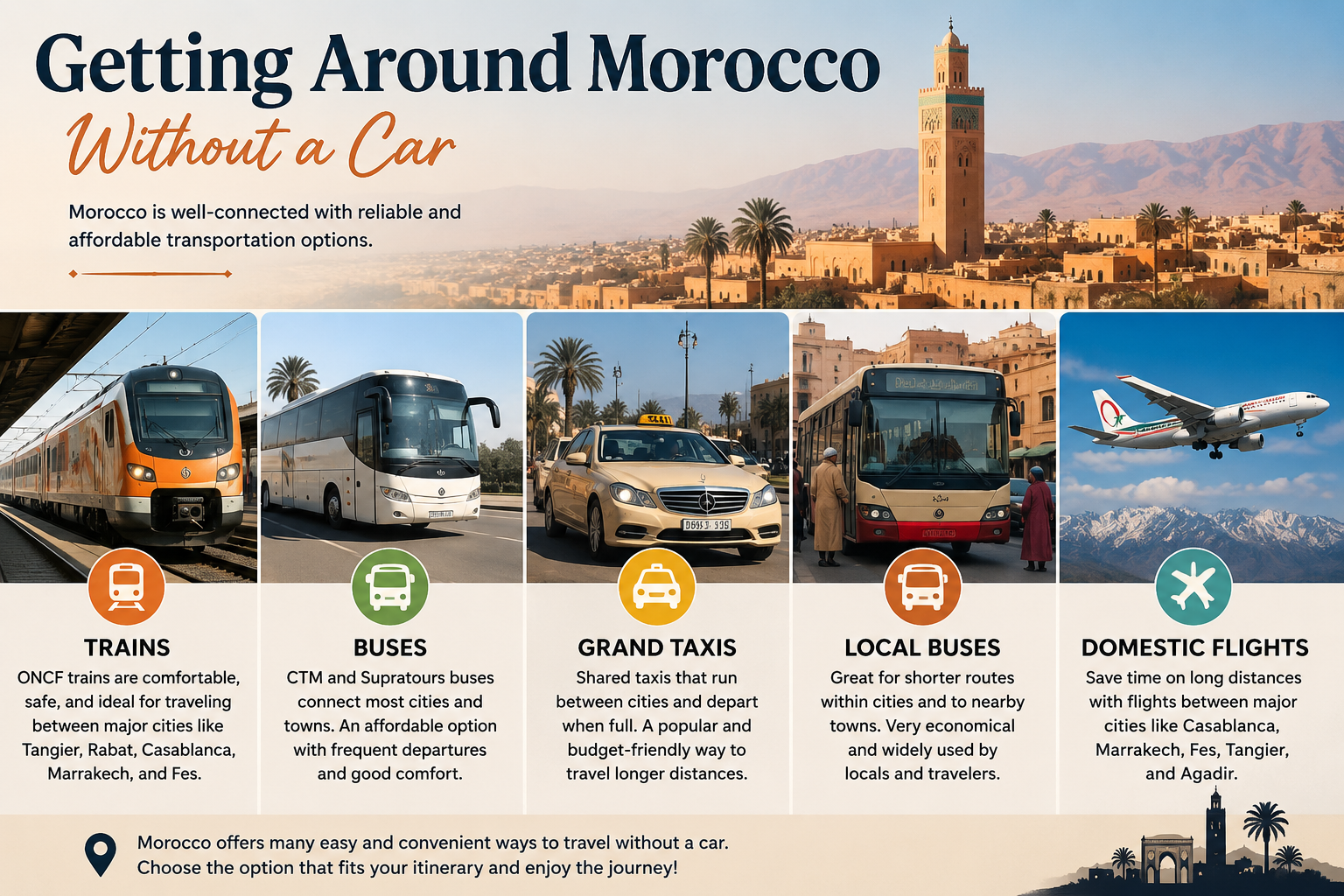 Why Morocco Is Easy to Explore Without a Car?
Morocco is one of the most accessible countries in North Africa for independent travelers who prefer not to drive. Thanks to its extensive public transportation system, you can move smoothly between imperial cities, coastal towns, mountain villages, and desert gateways using trains, buses, taxis, and organized transfers. For most visitors, getting around Morocco without a car is not only possible but often more comfortable, economical, and stress-free than renting a vehicle.
One of Morocco’s greatest strengths is its well-connected rail network. ONCF operates modern trains that link key destinations such as Tangier, Rabat, Casablanca, Marrakech, and Fez. The high-speed Al Boraq train makes northern travel especially efficient, reducing journey times and offering a comfortable alternative to long road trips.
Beyond the train network, premium intercity buses such as CTM and Supratours connect destinations that do not have rail service. This includes popular places like Chefchaouen, Essaouira, and Merzouga near the Sahara Desert. These buses are comfortable, affordable, and widely trusted by both locals and international tourists.
Morocco also offers flexible transportation options for shorter routes. Grand taxis operate between towns and villages, while petit taxis provide inexpensive transportation within cities. Private transfers and guided tours are ideal for travelers who want added comfort, personalized service, or easy access to remote destinations such as the Atlas Mountains and the Sahara.
Affordability is another major reason Morocco is easy to explore without a car. Train and bus tickets cost far less than renting a vehicle, and you avoid additional expenses such as fuel, tolls, parking fees, and insurance. For budget travelers, backpackers, and families, public transportation in Morocco delivers excellent value.
Traveling without a car also allows you to immerse yourself more deeply in Moroccan culture. You can observe daily life, meet local people, and enjoy the journey itself while experienced drivers handle the roads. This is particularly helpful in busy cities where traffic can be intense and navigating medinas can be challenging.
For solo female travelers, Morocco’s organized transportation system provides a safe and practical way to travel independently. With careful planning and local guidance from Tilila Travel, women can confidently explore the country while enjoying the flexibility and security of well-established transport networks.
Whether you want to visit ancient medinas, Atlantic beaches, mountain kasbahs, or the golden dunes of the Sahara, Morocco makes it remarkably easy to travel without driving. With modern trains, dependable buses, affordable taxis, and expertly curated itineraries, you can experience the country comfortably and confidently without renting a car.
Best Ways to Get Around Morocco Without a Car
The best way to get around Morocco without a car is to combine several transportation options based on your route, budget, and travel preferences. Morocco’s trains, buses, taxis, private transfers, and guided tours each serve different purposes, and together they make it easy to explore virtually every major destination in the country.
ONCF Trains for Fast and Comfortable Travel
For journeys between major cities, ONCF trains are the most efficient and comfortable option. They connect Tangier, Rabat, Casablanca, Marrakech, and Fez, offering spacious seating, air conditioning, and affordable fares. First-class tickets provide assigned seats and extra comfort, making train travel in Morocco especially attractive for long-distance routes.
CTM and Supratours Buses for Destinations Beyond the Rail Network
When trains are not available, CTM and Supratours buses offer reliable service to popular destinations such as Chefchaouen, Essaouira, and Merzouga. These companies are known for punctual schedules, secure luggage handling, and tourist-friendly booking systems. For many travelers, they are the best bus options in Morocco.
Grand Taxis for Regional Transportation
Grand taxis are shared vehicles that travel fixed routes between towns and cities. They are particularly useful for reaching places with limited train or bus connections. Although less spacious than trains or premium buses, they provide a fast and authentic local travel experience.
Petit Taxis for Getting Around Cities
Petit taxis operate within city limits and are ideal for traveling between train stations, hotels, medinas, and attractions. They are inexpensive and widely available in cities such as Marrakech, Fez, and Casablanca.
Private Transfers for Comfort and Flexibility
Private transfers are perfect for families, couples, and travelers who value convenience. They provide direct door-to-door service and are especially useful for destinations in the Atlas Mountains, remote kasbahs, and luxury desert camps.
Guided Tours for the Sahara and Remote Regions
For routes to the Sahara Desert and other remote areas, guided tours offer a seamless solution. These tours typically include transportation, accommodation, and local guides, making them one of the easiest ways to experience Morocco’s most dramatic landscapes.
Domestic Flights for Long Distances
Domestic flights can save time on routes such as Casablanca to Dakhla or Marrakech to Agadir, although most classic tourist circuits are easily completed by train and bus.
In most cases, travelers use a combination of these transportation methods. For example, you might take the train from Tangier to Marrakech, a bus to Essaouira, and a guided tour to the Sahara Desert. This flexible approach allows you to enjoy Morocco’s rich diversity without the challenges of self-driving.
At Tilila Travel, we help visitors choose the most efficient transportation options and design custom Morocco itineraries that balance independence, comfort, and authentic local experiences.
Morocco Train Travel Guide: How to Travel Around Morocco by Train?
Traveling by train is one of the easiest, fastest, and most comfortable ways to get around Morocco without a car. For many visitors, the Moroccan rail network provides the ideal balance of convenience, affordability, and reliability. If you plan to visit major cities such as Tangier, Rabat, Casablanca, Marrakech, and Fez, train travel in Morocco should be the foundation of your itinerary.
The national railway operator, ONCF, runs an extensive network that connects Morocco’s most popular tourist destinations. Trains are modern, air-conditioned, and generally punctual, making them an excellent option for first-time visitors, families, couples, and solo travelers. Stations are centrally located, which makes it easy to reach hotels, medinas, and major attractions.
One of the highlights of train travel in Morocco is Al Boraq, Africa’s first high-speed train. Al Boraq links Tangier, Kenitra, Rabat, and Casablanca, significantly reducing travel times in northern Morocco. For example, the journey from Tangier to Casablanca takes only a few hours, allowing travelers to cover long distances comfortably and efficiently.
Although trains do not reach every destination, they serve the country’s most important urban centers. Routes such as Casablanca to Marrakech, Marrakech to Fez (with a connection), and Rabat to Tangier are among the most popular. For places beyond the rail network, including Chefchaouen, Essaouira, and Merzouga, travelers can easily continue by bus or private transfer.
Moroccan trains offer first-class and second-class seating. First class provides reserved seats and a quieter environment, while second class is more economical and still comfortable. For longer journeys, first class is often worth the small additional cost.
Booking train tickets in Morocco is straightforward. You can purchase them in advance through the official ONCF website, at train stations, or via mobile apps. Booking ahead is recommended during holidays and busy travel seasons, especially for popular routes and high-speed trains.
Train travel is also budget-friendly. Fares are reasonable, and the overall cost is significantly lower than renting a car when you consider fuel, tolls, parking, and insurance. This makes trains one of the best transportation options in Morocco for budget-conscious travelers.
From a travel experience perspective, trains offer a relaxing way to see Morocco’s changing landscapes, from Atlantic coastlines and fertile plains to the foothills of the Atlas Mountains. You can enjoy the journey, work on your itinerary, or simply admire the scenery while someone else handles the logistics.
At Tilila Travel, we frequently recommend train travel as the backbone of a Morocco itinerary without a car. By combining ONCF trains with buses, private transfers, and curated experiences, travelers can explore Morocco comfortably and efficiently while enjoying authentic local connections.
In short, if you are wondering how to travel around Morocco by train, the answer is simple: use ONCF and Al Boraq to connect the country’s major cities quickly, safely, and affordably.
Morocco Bus Travel Guide: CTM vs Supratours
For destinations that are not served by the rail network, buses are the best way to get around Morocco without a car. Comfortable, affordable, and widely available, Morocco’s long-distance bus system connects mountain towns, coastal cities, and desert gateways with remarkable efficiency. Among the many operators, CTM and Supratours stand out as the most reliable and tourist-friendly options.
CTM is Morocco’s most established intercity bus company. It serves an extensive network of destinations, including Chefchaouen, Essaouira, Agadir, Ouarzazate, and Merzouga. CTM buses are known for their air-conditioned coaches, assigned seating, secure luggage handling, and professional service. For many travelers, CTM is the preferred choice for long-distance travel in Morocco.
Supratours, a subsidiary associated with ONCF, complements the train system by connecting rail passengers to destinations beyond the tracks. It is especially useful for routes such as Marrakech to Essaouira and overnight journeys toward the Sahara Desert. Travelers who appreciate the convenience of integrated train and bus travel often choose Supratours.
When comparing CTM vs Supratours, both companies offer comfortable and dependable service. CTM typically has a broader route network, while Supratours is particularly convenient for travelers already using ONCF trains. The best choice often depends on your schedule, departure times, and destination.
Buses are essential for reaching some of Morocco’s most iconic destinations. Chefchaouen, the famous Blue City in the Rif Mountains, is most commonly reached by bus. Essaouira, the relaxed Atlantic port town, is easily accessible from Marrakech. Merzouga, the gateway to the Sahara Desert, is also commonly reached by long-distance bus or organized desert tour.
Booking bus tickets in Morocco is simple. You can reserve seats online through the official websites of CTM and Supratours, or purchase tickets at bus stations. Advance booking is recommended during peak seasons and for overnight routes.
Bus travel in Morocco is highly affordable and often costs only a fraction of what you would spend on car rental, fuel, and tolls. For independent travelers, backpackers, and families, buses offer outstanding value.
Safety is another reason travelers trust CTM and Supratours. These companies maintain strong reputations for dependable service, organized boarding, and secure baggage systems, making them excellent choices for first-time visitors and solo female travelers.
At Tilila Travel, we regularly incorporate CTM and Supratours into custom itineraries, helping travelers combine buses with trains, private transfers, and guided tours for a seamless experience across Morocco.
If you want to visit destinations beyond the rail network, Morocco’s premium bus companies provide a comfortable and reliable way to explore the country without renting a car.
Grand Taxis in Morocco Explained
Grand taxis are one of the most practical and authentic ways to get around Morocco without a car, especially when you want to travel between smaller towns, rural areas, and destinations that are not directly served by trains or premium buses. These shared taxis form an essential part of Morocco’s transportation system and give travelers a flexible alternative to scheduled public transport.
Unlike petit taxis, which operate only within city limits, grand taxis connect cities, villages, and regional hubs. Most grand taxis are large sedans or minivans that follow fixed routes and depart once all seats are filled. Locals use them daily because they are affordable, widely available, and often faster than waiting for infrequent buses.
Grand taxis are particularly useful for short and medium-distance routes. They are commonly used for journeys such as Fez to Chefchaouen, Marrakech to the foothills of the Atlas Mountains, and transfers between train stations, bus depots, and nearby towns. In remote regions, grand taxis may be the only practical transportation option.
The cost of a grand taxi ride depends on the route, distance, and whether you share the vehicle or hire it privately. Shared rides are very economical because passengers split the fare. If you prefer more comfort, flexibility, or extra luggage space, you can pay for all seats and use the vehicle as a private transfer.
Using grand taxis in Morocco is straightforward. You go to the designated grand taxi station, known locally as a taxi stand, state your destination, and wait until the vehicle fills. Drivers usually know the standard fares, but confirming the price before departure is always a good idea.
For travelers who want an authentic local experience, grand taxis offer a fascinating glimpse into everyday Moroccan life. You may share the ride with families, students, and workers while passing through scenic countryside, mountain roads, and traditional villages.
Safety is generally good, especially during daytime travel. Choose official taxi stands, keep valuables with you, and avoid overcrowded vehicles if comfort is a priority. Solo female travelers often find grand taxis safe and convenient, particularly when arranged through a trusted guide or local travel specialist.
At Tilila Travel, we often incorporate grand taxis into customized Morocco itineraries when they provide the most efficient connection between destinations. Combined with trains, buses, and private transfers, they make it possible to reach places that many visitors would otherwise miss.
If you are exploring Morocco without renting a car, grand taxis are an affordable, flexible, and culturally immersive transportation option that can help you travel beyond the main tourist routes.
Petit Taxis in Morocco: Getting Around Moroccan Cities
Petit taxis are the easiest and most affordable way to get around Morocco’s cities without a car. These small urban taxis operate strictly within city limits and are ideal for short-distance travel between train stations, hotels, medinas, restaurants, and tourist attractions. Whether you are exploring Marrakech, Fez, Casablanca, or Tangier, petit taxis provide a fast, convenient, and budget-friendly transport option.
City-Based Taxi System in Morocco
Each Moroccan city uses a distinct color system for petit taxis, which makes them easy to identify. For example, Marrakech taxis are typically beige, while Casablanca taxis are red. Although the colors differ, the service structure remains the same across the country, and all licensed taxis operate under regulated urban transport rules.
Meter System and Fare Rules
Most petit taxis are equipped with meters, and this is the preferred way to calculate fares. Travelers are advised to ensure the meter is turned on at the beginning of the ride. If a driver prefers a fixed price instead, the fare should be clearly agreed upon before entering the taxi to avoid misunderstandings.
When to Use Petit Taxis in Morocco
Petit taxis are especially useful when traveling short distances, such as moving from a hotel to a medina, reaching bus stations, or returning from evening outings. They are also helpful when walking is inconvenient due to heat, luggage, or time constraints.
Affordable Urban Transport Option
One of the biggest advantages of petit taxis is affordability. Short trips typically cost only a small amount, making them one of the cheapest transportation options in Moroccan cities. Despite low prices, service quality is generally reliable and widely available throughout the day.
Safety Tips for Travelers
Petit taxis are generally safe when used correctly. Travelers should use official licensed taxis, confirm the destination before departure, and carry small change for payments. Using navigation apps can also help ensure the correct route is being followed.
Ideal for Solo and Female Travelers
For solo and female travelers, petit taxis are often a preferred option, especially in busy urban areas or during nighttime hours. They provide a safer alternative to walking long distances in unfamiliar neighborhoods.
Connection With Trains and Buses
Petit taxis play an important role in connecting Morocco’s public transport system. After arriving by ONCF trains or intercity buses like CTM, taxis provide quick last-mile transport to riads, hotels, and attractions.
Petit taxis complete the travel experience by making city navigation simple, flexible, and efficient. When combined with trains, buses, and regional transport, they ensure that getting around Morocco without a car remains smooth and stress-free.
Transportation Costs in Morocco Without a Car
One of the biggest advantages of getting around Morocco without a car is the overall affordability of transportation. Compared to renting a vehicle, paying for fuel, highway tolls, parking, and insurance, public transport in Morocco offers a far more budget-friendly way to explore the country. Whether you are traveling by train, bus, taxi, or private transfer, costs remain relatively low and predictable.
The national railway system operated by ONCF provides some of the best value for long-distance travel. Train tickets between major cities such as Tangier, Rabat, Casablanca, Marrakech, and Fez are reasonably priced, with first-class options available for extra comfort. Even high-speed travel on Al Boraq remains affordable compared to similar services in Europe.
Long-distance buses are another cost-effective option. Companies like CTM and Supratours offer comfortable journeys at low prices, especially for routes to destinations such as Chefchaouen, Essaouira, and Merzouga near the Sahara Desert. Bus travel is often the cheapest way to cover long distances in Morocco.
Within cities, petit taxis are extremely inexpensive, with short rides costing only a small amount. Grand taxis, which operate between towns and regions, become even more economical when shared with other passengers. For travelers seeking convenience, private transfers cost more but still remain reasonable compared to Western travel standards.
A typical 7–10 day Morocco itinerary without a car might include a combination of trains and buses, costing significantly less than car rental. Most travelers find that daily transportation expenses remain manageable even when moving frequently between cities.
Overall, Morocco offers excellent value for money when it comes to transportation. By mixing trains, buses, taxis, and occasional private transfers, you can comfortably explore the entire country without overspending.
Best Routes for Getting Around Morocco Without a Car
Planning the right routes is key to successfully exploring Morocco without a car. The country’s transportation network is designed around major travel corridors that connect imperial cities, coastal towns, mountain regions, and desert gateways. By combining trains, buses, and taxis, you can easily build a smooth and efficient itinerary across Morocco without driving.
Tangier to Marrakech Route (Fastest North–South Connection)
One of the most popular routes is between Tangier and Marrakech. This journey is typically completed using the high-speed Al Boraq train to Casablanca, followed by a connection to Marrakech. This route allows travelers to experience both northern and central Morocco efficiently.
Marrakech to Fez Route (Imperial Cities Journey)
Another essential route is Marrakech to Fez, which connects two of Morocco’s most historic imperial cities. This trip is commonly done by train, offering scenic views of Morocco’s changing landscapes along the way. From Fez, travelers can easily continue north to Tangier or head west toward Casablanca.
Marrakech to Essaouira Route (Coastal Escape)
For coastal exploration, the route between Marrakech and Essaouira is extremely popular. Since there is no train line to Essaouira, travelers typically use CTM or Supratours buses, which provide direct, comfortable service. This makes it one of the easiest beach escapes from Marrakech.
Tangier or Fez to Chefchaouen Route (Blue City Access)
A key highlight for many visitors is the journey to Chefchaouen, the famous Blue City in the Rif Mountains. Because Chefchaouen is not connected by rail, travelers usually take a bus from Tangier or Fez, or combine train and bus travel for the most efficient route.
Marrakech or Fez to Sahara Desert Route (Merzouga Journey)
Reaching the Sahara Desert, especially the dunes near Merzouga, requires a combination of transport methods. Most travelers take a train or bus to Fez or Marrakech and then continue by bus, private transfer, or organized desert tour. This route is longer but is one of the most rewarding travel experiences in Morocco.
These routes form the backbone of any Morocco itinerary without a car. By understanding how cities are connected, travelers can easily move across the country without confusion or delays.
At Tilila Travel, we specialize in designing optimized Morocco travel routes that combine trains, buses, and private transfers. This ensures smooth connections, minimal waiting time, and maximum travel experience across Morocco’s most iconic destinations.
How to Get to Chefchaouen Without a Car?
Reaching Chefchaouen without a car is simple, but it requires a combination of Morocco’s train and bus network because the city is not directly connected by rail. Most travelers use Tangier or Fez as the main gateway before continuing by road transport.
The most common route is to take an ONCF train to Tangier or Fez, and then switch to a CTM or Supratours bus for the final leg of the journey. These buses are comfortable, air-conditioned, and designed for long-distance travel, making the journey smooth even through the Rif Mountains.
From Tangier, the bus ride to Chefchaouen takes around 2–3 hours, while from Fez it usually takes about 4–5 hours. The roads are scenic, passing through mountains, valleys, and traditional villages, which makes the journey itself part of the travel experience.
Another option is a grand taxi from Tangier or Fez. Although slightly faster in some cases, grand taxis are shared and can feel less comfortable than buses. For travelers who prefer privacy and convenience, private transfers or guided tours are also available and widely used.
Chefchaouen is one of the easiest mountain destinations in Morocco to reach without driving. With a simple connection from train to bus, travelers can explore its blue-painted streets, relaxed atmosphere, and photogenic medina without needing a rental car.
At Tilila Travel, we often recommend combining Tangier or Fez arrivals with direct bus transfers to Chefchaouen for the smoothest experience. This route is especially popular among first-time visitors and solo travelers.
How to Reach the Sahara Desert Without Renting a Car?
Visiting the Sahara Desert without a car is completely possible and is one of the most popular travel experiences in Morocco. The most common gateway to the desert is Merzouga, home to the famous Erg Chebbi dunes.
Because there is no direct train to the desert, travelers usually combine multiple transport modes. The most efficient route is to take an ONCF train to Fez or Marrakech, and then continue by CTM or Supratours bus toward Merzouga or nearby desert towns.
From Marrakech, the journey typically involves an overnight bus or a private transfer through the Atlas Mountains and desert gateways such as Ouarzazate and Erfoud. From Fez, buses travel through Midelt and the Ziz Valley, offering dramatic landscapes along the way.
For most travelers, however, the easiest and most stress-free way to reach the Sahara Desert is by joining a guided desert tour. These tours include transportation, accommodation in desert camps, meals, and camel trekking experiences. This option eliminates the need to coordinate multiple connections and is especially popular for first-time visitors.
Private transfers are another alternative for travelers who want more comfort and flexibility. While more expensive than buses, they allow for stops along the way and a more personalized journey through Morocco’s southern landscapes.
Even though the desert is far from major cities, the journey is well organized and widely traveled. Thousands of visitors reach the Sahara every day without renting a car, proving that Morocco’s transport system is fully capable of supporting long-distance travel.
At Tilila Travel, we specialize in arranging seamless Sahara Desert experiences using a combination of trains, buses, and guided tours. This ensures travelers enjoy the magic of the dunes without the stress of self-driving through remote terrain.
Best Cities and Destinations to Visit in Morocco Without a Car
Morocco is full of incredible destinations that are perfectly accessible without renting a car. Thanks to the country’s strong network of trains, buses, and taxis, you can easily explore imperial cities, coastal towns, mountain villages, and desert regions using public transportation alone.
Marrakech – The Cultural Heart of Morocco
One of the top destinations is Marrakech. Known for its vibrant medina, bustling souks, and historic landmarks, Marrakech is well connected by ONCF trains and serves as a major travel hub for onward journeys.
Fez – The Ancient Imperial City
Another must-visit city is Fez, one of the oldest imperial cities in the world. Its ancient medina, traditional craftsmanship, and cultural heritage make it a highlight of any Morocco itinerary. Fez is easily accessible by train from Casablanca, Rabat, and Tangier.
Tangier – Gateway Between Europe and Morocco
On the northern coast, Tangier offers a mix of Mediterranean and Atlantic influences. With high-speed rail connections via Al Boraq, it is one of the easiest cities to reach without a car.
Essaouira – Relaxed Coastal Escape
For a more relaxed coastal experience, Essaouira is a favorite among travelers. Known for its windy beaches, artistic vibe, and laid-back atmosphere, it is easily accessible by bus from Marrakech.
Chefchaouen – The Blue Pearl of Morocco
In the mountains, Chefchaouen stands out as one of Morocco’s most picturesque towns. Its blue-painted streets and peaceful environment make it a top destination for photographers and slow travelers. Although not connected by train, it is easily reached by bus or grand taxi.
Merzouga – Gateway to the Sahara Desert
For desert adventures, Merzouga serves as the gateway to the Sahara Desert. Travelers typically arrive via Fez or Marrakech using buses or guided tours before continuing to the dunes.
Rabat, Casablanca & Agadir – Modern Coastal Cities
Other easily accessible destinations include Rabat, Casablanca, and Agadir, all of which are well connected by trains and buses. Each city offers a unique perspective on Moroccan culture, from modern coastal life to historic imperial heritage.
Together, these destinations form a complete Morocco experience that can be enjoyed entirely without a car. With the right combination of trains, buses, and local transport, you can explore the entire country comfortably, safely, and efficiently.
Frequently Asked Questions About Getting Around Morocco Without a Car
Is it easy to get around Morocco without a car?
Yes, it is very easy to get around Morocco without a car. The country has a strong transport network including ONCF trains, CTM and Supratours buses, and grand taxis that connect most tourist destinations. Major cities like Marrakech, Casablanca, and Fez are well linked, so travelers can move around comfortably without driving.
What is the best way to travel around Morocco without a car?
The best way is to combine transport options. Use trains for long-distance routes between major cities, buses for destinations not connected by rail like Chefchaouen and Essaouira, and taxis for short city trips. The high-speed Al Boraq train is especially useful for fast travel in northern Morocco.
Are trains in Morocco reliable for tourists?
Yes, trains in Morocco are generally reliable, clean, and punctual. The network operated by ONCF connects most major cities and is considered one of the most efficient ways to travel in the country.
Which is better in Morocco: CTM or Supratours?
Both are excellent options. CTM has a wider network and more frequent departures, while Supratours is often more convenient for connecting with train routes. Both are safe, comfortable, and widely used by tourists.
Can you go to the Sahara Desert without a car?
Yes, you can reach the Sahara Desert without a car by taking a train to Fez or Marrakech and continuing by bus, private transfer, or guided tour to Merzouga.
Is public transportation in Morocco safe?
Yes, public transportation in Morocco is generally safe for tourists, including solo female travelers. Using official services like ONCF trains, CTM buses, and licensed taxis is recommended for a safe and comfortable experience.
Final Thoughts on Getting Around Morocco Without a Car
Traveling around Morocco without a car is not only possible—it is often the smartest way to explore the country. With a well-connected network of trains, buses, and taxis, you can move easily between imperial cities, coastal towns, mountain villages, and desert landscapes without the stress of driving.
The combination of ONCF trains, CTM and Supratours buses, and local taxis creates a flexible and reliable transport system that supports almost every travel route in the country. Whether you are visiting Tangier, exploring the medinas of Fez, relaxing in Essaouira, or heading toward the dunes of the Sahara Desert, everything can be done smoothly without renting a car.
For many travelers, avoiding driving actually improves the experience. You save money, reduce stress, and gain more time to enjoy Morocco’s culture, landscapes, and local life. Journeys become part of the adventure rather than a logistical challenge.
At Tilila Travel, we design Morocco itineraries that fully eliminate the need for self-driving while maximizing comfort and authenticity. By combining transport options strategically, travelers can enjoy a seamless and unforgettable journey across Morocco.
In the end, getting around Morocco without a car is simple, affordable, and highly rewarding—making it one of the best countries in the world for car-free travel.
