
Travelers’ Comprehensive Guide on Credit Cards, Cash, and Tipping in Morocco
Before traveling to Morocco, we at Tilila Travel want each visitor to feel at ease and well-prepared. Moroccan Cards, Cash, and Money & Tipping Guide for Morocco Travelers: One of the most frequent queries from tourists is whether they need to bring cash or if they can use credit cards while traveling.
Morocco Travel Guide: Cards, Cash, and Tipping
The short answer is that you should bring some Moroccan currency and a credit/debit card when you travel. Although Morocco’s major cities and tourist attractions have modern payment options, cash is still crucial for local experiences, minor purchases, tips, and rural travel.
This guide describes Moroccan tipping norms, where cash is preferred, and where credit cards are typically accepted.
Are Credit Cards Acceptable in Morocco?
Indeed, credit cards are accepted in numerous Moroccan locations, particularly in bigger towns and tourist destinations. The two most popular cards are Visa and Mastercard. Although it is less prevalent, American Express might be accepted in some upscale hotels or businesses.
Morocco is not entirely cashless, though. Cash is still preferred or accepted exclusively by many local businesses, tiny shops, traditional markets, taxis, and rural areas. Because of this, we advise carrying a respectable quantity of Moroccan Dirhams throughout the day.
Locations That Typically Accept Credit Cards
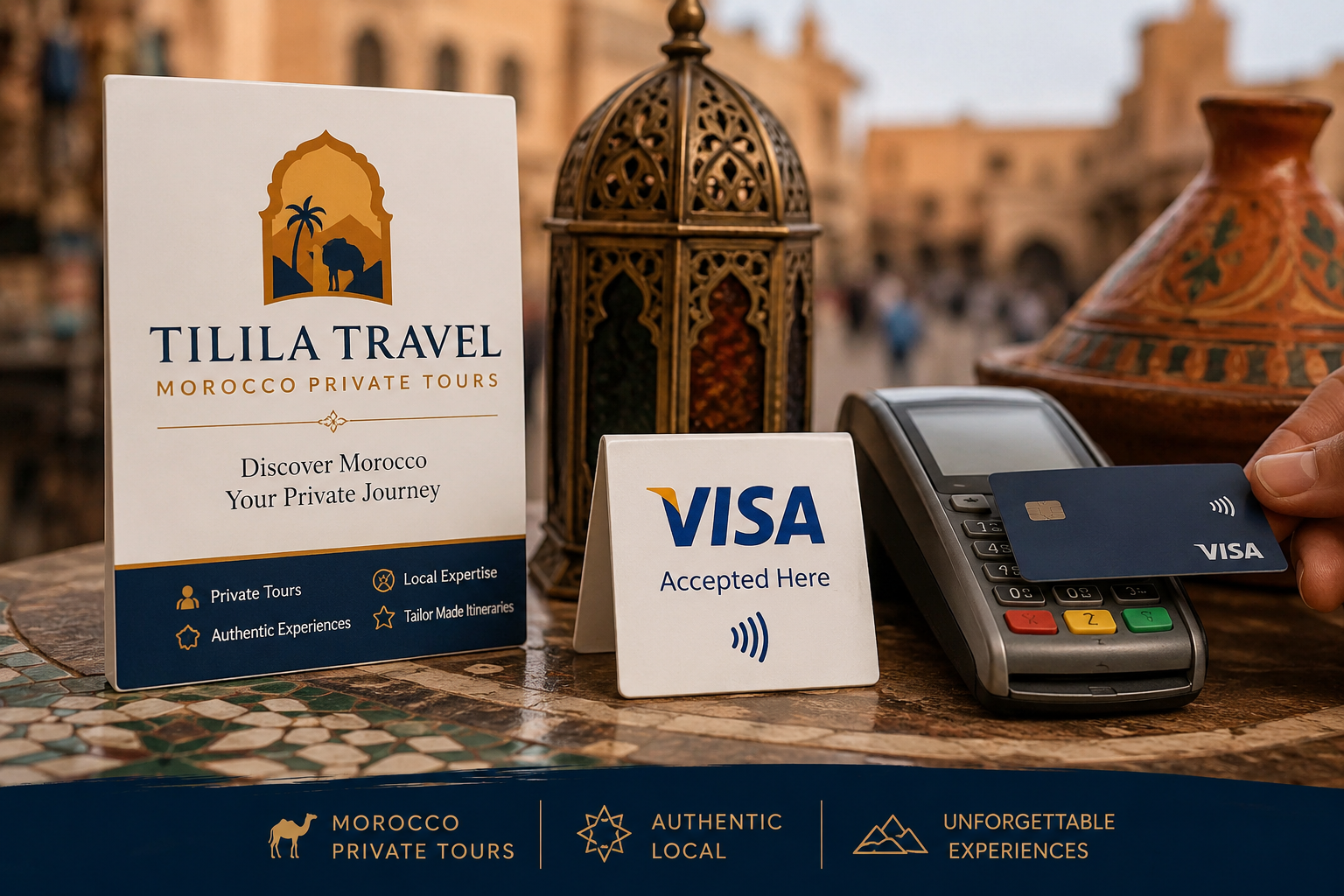
The following locations frequently take credit cards:
Hotels, Riads, and Exquisite Lodging
Credit cards are accepted at the majority of larger hotels, foreign hotels, opulent riads, and reputable lodgings. Higher-end establishments in major towns including Marrakech, Fes, Casablanca, Rabat, Tangier, Agadir, and Chefchaouen typically accept card payments.
Cards may also be accepted at smaller traditional riads, however some might prefer cash or charge a modest processing fee. It’s best to confirm ahead of time.
Elegant and Tourist-Friendly Dining Establishments
Credit cards are accepted at many restaurants in tourist locations, particularly at mid-range and upscale establishments. Marrakech, Fes, Casablanca, Rabat, Tangier, Agadir, Essaouira, and other well-known locations frequently experience this.
However, family-run businesses and tiny local eateries could only take cash.
Modern Stores & Shopping Malls
In big cities, card payments are typically accepted at shopping centers, supermarkets, fashion stores, pharmacies, other contemporary retail establishments. Larger supermarkets, branded stores, and contemporary shopping malls are a few examples.
Gardens, Museums, and Tourist Attractions
Card payments may be accepted at several popular tourist destinations, museums, gardens, and monuments, particularly in bigger towns. But this isn’t always the case, so it’s a good idea to have cash on hand for admission.
Travel Services & Tour Companies
Card payments, bank transfers, and internet payments are accepted by many reputable tour operators, travel agencies, and private excursion providers. Paying deposits or sums in advance via card or transfer is typical for private Morocco vacations.
Travelers should still bring cash for personal costs, tips, small purchases, refreshments, and extra activities during the tour itself.
Locations Where Cash Is Needed or Suggested
In Morocco, money is still incredibly significant. In the following circumstances, visitors should anticipate using Moroccan dirhams:
Traditional Markets and Souks
Cash is the most popular form of payment in the medinas and souks of Marrakech, Fes, Chefchaouen, Essaouira, and other ancient cities. Cards are not accepted by many small businesses, artist booths, spice stores, carpet vendors, and souvenir dealers.
Cash is still preferred, especially when negotiating, however some larger or fixed-price stores may accept cards.
Street food, local eateries, and small cafes
Local eateries, juice stands, food stalls, bakeries, tiny eateries, and traditional cafés frequently only take cash. Cash is more quicker and easier for modest sums.
Local Transportation & Taxis
Cash is required for the majority of minor transport services, local taxis, and petit taxis. Regular cabs typically do not accept card payments.
The primary service is typically scheduled in advance if you are employing a private driver as part of your Tilila Travel tour, but you could still require cash for unforeseen charges.
Desert Regions, Mountains, and Rural Areas
Cash is crucial in isolated places, tiny towns, desert regions, rural communities, and the Atlas Mountains. Card machines might not function consistently, and ATMs can be scarce or nonexistent.
It is preferable to withdraw enough Moroccan Dirhams at a bigger city before visiting the Atlas Mountains, the Sahara Desert, or other remote locations.
Advice & Small Services for Tipping Guide Morocco Travel
Almost always, tips are offered in cash. Tips for drivers, porters, housekeepers, restaurant employees, local guides, and desert camp personnel are all included.
Keeping tiny notes and coins on hand is useful for modest transactions and tipping.
Parking, public restrooms, and small local fees
A minor cash contribution is required for parking attendants, luggage assistants, public restrooms, and other small local services. Although they are typically tiny sums, it is helpful to have coins or small notes.
Suggested Money Advice for Travelers
We advise tourists to bring a mix of:
A debit or credit card for major expenditures, lodging, and dining out
Moroccan Dirhams for everyday costs, gratuities, cafes, souks, taxis, and rural locations
Coins and tiny notes for convenient modest payments and tipping
The majority of cities and popular tourist locations have ATMs, although it is preferable to take out cash now rather than waiting until you are in a remote location. Take out funds ahead of time while visiting the highlands or desert.
Tipping Guide Morocco Travel
Although it is not required, tipping is common and valued in Morocco, particularly when traveling. As a token of gratitude for excellent service, tips are always provided, and the amounts are negotiable.
The purpose of the following advice is to assist travelers in making comfortable, stress-free plans. Your happiness with the service you received should always be reflected in your tip.
Private Driver: Cash Tipping, Cards, and Morocco Travel Guide
One of the most crucial individuals on many Morocco vacations is the private driver. Throughout the trip, your driver is frequently with you to help with transportation, luggage, timing, local guidance, comfort, and general assistance.
The driver’s tip is typically the most important because of this ongoing service.
Suggested range: Tipping Guide Morocco Travel
A total of €10–15 per day for all travelers
For instance, this sum is typically stated as a shared daily amount rather than per person if two travelers are on the same tour.
Generally speaking, the best course of action is to save the tip till the very end of the trip and present it as a last thank you. You can even divide it into two sections, for example, halfway through the tour and the remainder at the conclusion, if you’d like.
City Guides with Local Licenses : Tipping Guide Morocco Travel
Travelers may be escorted by certified local guides for walking tours and cultural trips in towns like Fes, Marrakech, Meknes, Rabat, or other historical locations.
Through the medina, monuments, and traditional neighborhoods, these guides typically offer historical explanations, local context, and assistance.
Suggested range:Tipping Guide Morocco Travel
A full-day excursion costs €10–15 per guide.
This is often provided at the conclusion of the guided visit. Travelers can modify the cost based on the duration and caliber of the service if the tour is shorter.
Staff at Desert Camp and Merzouga
Staff members frequently help with luggage, food, room preparation, camel arrangements, camp comfort, and general hospitality in desert camps or desert-edge resorts in the Merzouga region.
Although tipping is entirely voluntary, it is valued when service is satisfactory.
Suggested range:
€5–10 per night in total
Usually, this can be given to the camp manager to distribute to the workers or put in a general tip box. Because multiple people may contribute to the guest experience behind the scenes, this is frequently the most equitable choice.
Tipping Guide Morocco Travel: Cards, Cash Tipping, Hotel & Riad Staff
In Morocco, employees of hotels and riads frequently offer friendly, individualized service. Tiny gratuities are valued, particularly when employees assist with housework or luggage.
Porters assisting with bags:
€1–2 for each bag
Cleaning: €1–2 per night, left in the room
Although they are not necessary, these gratuities are appreciated when the service is competent and helpful.
Cafés & Restaurants : Tipping Guide Morocco Travel
Tipping is typical when service is good in restaurants that are popular with tourists.
Suggested range for dining establishments:
5–10% of the total amount
Simply rounding up the amount or leaving a few tiny coins is completely acceptable in small cafés or informal local establishments.
Travelers can verify whether a service charge has already been applied before leaving a tip. An extra tip is optional if the service is included.
Last Thoughts from Tilila Travel
Morocco is a friendly nation where hospitality plays a significant cultural role. Although credit cards are helpful in many contemporary locations, cash is still necessary for a nice and easy trip.
For optimal enjoyment, we advise travelers to:
Bring Moroccan dirhams and a card.
Save little coins and notes for modest purchases and tips.
Take out cash before visiting the desert, mountains, or rural places.
In hotels, larger restaurants, shopping centers, and contemporary stores, use cards.
Pay with cash in traditional marketplaces, souks, taxis, modest cafés, and isolated locations.
Only tip when they believe the service is worthwhile.
In Morocco, leaving a tip is valued and never required. It’s just a kind way to express gratitude for excellent service.
Tipping Guide Morocco Travel: Cards, Cash, and Tipping
In order for visitors to enjoy Morocco with assurance, comfort, and peace of mind, Tilila Travel is always pleased to offer advice both before and during their trip.
