
Introduction
Most people visit Morocco, but they don’t really experience it. Not because they don’t want to but because their trip never gives them the chance. Everything is timed. You’re in Fes for a couple of hours, you see the highlights, take the photos, and move on. By the end of the day, you’ve seen a lot, but it all feels a bit surface-level.
Then there’s the other side of it. You walk into the medina early, before it gets busy. Someone invites you in for tea, you stay longer than planned, and suddenly the experience feels personal. In the desert, it’s quiet not crowded and you actually take it in.
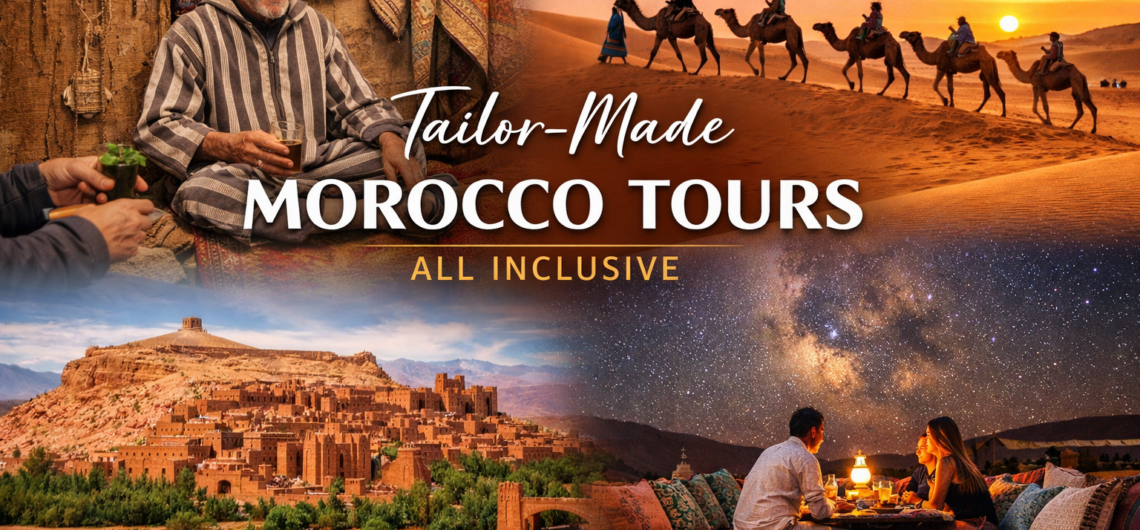
That difference usually comes down to one thing: choosing a tailor-made Morocco tour all inclusive instead of following a fixed itinerary.
This guide covers everything you need to know to make the right choice. It draws on the expertise of Tilila Travel, a Marrakech-based operator that has spent years building custom private Morocco itineraries for travellers worldwide. By the end, you’ll know exactly what to expect, what to ask, and how to plan a Morocco trip worth talking about for years.
What “Tailor-Made Morocco Tours All Inclusive” Actually Means
Defining the Term Clearly
A tailor-made Morocco tour means your itinerary is built from scratch around your specific travel dates, starting city, interests, pace, and budget. There’s no fixed group to keep pace with, no predetermined route you can’t change, and no compromise on what you actually want to see. Prefer three days in Fes over a Casablanca stopover? That’s exactly what happens. Want to add a morning Atlas hike mid-trip? A good local operator makes it work.
What All Inclusive Covers
All inclusive, in the context of Morocco tour packages, typically means private transport throughout, accommodation every night, daily breakfast and selected dinners, professional English-speaking guide services, and all internal transfers. With a quality operator like Tilila Travel, coverage also extends to Saharan camp nights, camel treks, site access, and airport pickups — so no unwelcome surprises greet you on arrival.
What You’re Really Paying For
What you’re actually purchasing isn’t just convenience it’s expertise. Consider the guide who knows which café in Chefchaouen serves the best bissara. Or the driver who knows the Tizi n’Tichka road has a viewpoint that appears on no tourist map. Or the riad booking that places you inside the old city rather than beside a highway. Morocco rewards this kind of travel. The country’s depth historically, geographically, culturally simply can’t reach you through a coach window.

Why Morocco Demands a Personalised Approach
The Tourist Circuit Problem
Morocco welcomed over 14.5 million international visitors in 2023. That popularity, however, creates a well-worn tourist circuit: Djemaa el-Fna square, Ait Ben Haddou, a camel photo near Merzouga, Fes in three hours. Repeat.
Travellers who find Morocco genuinely life-changing are usually those who deviate from that circuit. They spend an extra day in Meknes when it rains in Fes. A private Morocco tour allows exactly this kind of responsiveness. When your itinerary is custom-built, it has room to breathe the plan becomes a framework, not a contract.
The Practical Planning Challenge
Morocco also presents a logistics challenge that deserves honest acknowledgement. The country spans over 700,000 square kilometres. Driving from Tangier to Merzouga takes around 11 hours. Moreover, the climate shifts dramatically between the Atlantic coast, the High Atlas, and the pre-Saharan south. Getting the routing right timing arrivals, placing accommodation genuinely inside the places worth exploring requires real local knowledge. That’s precisely where an experienced, locally rooted operator stops being a convenience and starts being essential.
Tilila Travel: Who They Are and Why Their Experience Matters
A Locally Based Operator With Real Regional Knowledge
Tilila Travel is a Morocco-based travel company specialising in custom private tours, multi-day Morocco itineraries, and Saharan desert experiences. Operating from Marrakech, they offer departures from every major Moroccan city including Casablanca, Fes, Tangier, Agadir, and Rabat.
What distinguishes them from international booking platforms is straightforward: they’re Moroccan. Their guides didn’t learn about the Draa Valley from a guidebook they’ve driven it hundreds of times across different seasons. When a mountain pass closes in winter, they know the alternative route. When a local Tuesday souk is particularly worth stopping at, they already plan around it.
Tour Range and Transparency
Their range is genuinely broad. Single-day activities start from €30, while multi-day tours run from 2-day desert escapes (€250) up to 21-day grand circuits (€3,750). Every itinerary between those extremes can be customised: starting point, accommodation style, pace, activities, dietary requirements, and language of guiding.
Pricing stays transparent throughout. No hidden fees, no commission-inflated add-ons. You know exactly what’s included before you commit.
Their Sustainability Commitment
Tilila Travel’s sustainability policy further sets them apart. They work with locally owned riads and guesthouses, employ Moroccan guides, and structure routes so that tourist spending flows into local communities rather than international chains. For travellers who care about where their money goes, this matters considerably.
Tailor-Made Morocco Itineraries: What’s Possible for Every Type of Traveller
The best way to understand what a custom Morocco tour looks like is to examine real itinerary frameworks across different durations.
The 3 to 5 Day Morocco Experience
Short on time but unwilling to compromise on substance? The 3-day desert tour from Fes to Marrakech is one of Tilila Travel’s most consistently praised itineraries. Departing Fes through the cedar forests of the Middle Atlas, you stop at the Volubilis ruins, cross the dramatic Ziz Valley, and reach the Erg Chebbi dunes near Merzouga in time for a sunset camel trek and a private desert camp night. The following morning, the route crosses south through the Draa Valley and Ouarzazate past the UNESCO-listed Ait Ben Haddou kasbah arriving in Marrakech by evening.
Seventy-two hours. Imperial history, mountain landscape, Saharan desert, and kasbahs completely private.
Alternatively, the 5-day desert tour from Marrakech to Merzouga adds the High Atlas crossing, the Todra Gorge, and time to genuinely absorb the Sahara rather than glance at it. At €1,050 per person, it’s arguably the most complete short Morocco experience available.
The 9-Day Morocco Classic Circuit
For most first-time visitors, nine days hits the sweet spot between coverage and depth. The standard circuit from Marrakech or Casablanca moves through the Atlantic coast (Rabat), the imperial cities (Meknes, Fes), the mountain passes, and the Saharan south returning via the Dadès and Draa valleys. There’s time to wander Fes’s medina without watching a clock, to walk the dunes before the desert heats up, and to spend a full evening in Marrakech’s old city without rushing to dinner.
Tilila Travel’s 9-day Morocco tour from Marrakech starts from €1,450 per person, with private transport, accommodation, and guided services included throughout.
The 12-Day Morocco Deep Dive
Two weeks is when Morocco truly opens up. A 12-day itinerary has room for Chefchaouen — the remarkable blue-washed Rif mountain city that photographers seek out specifically as well as Tangier, Morocco’s gateway to Europe, with its layered colonial history and revitalised medina.
The 12-day tour from Marrakech runs from €1,950 per person. It suits travellers who’ve read everything about Morocco and want to actually experience it without the pressure of rushing.
Extended and Luxury Circuits: 15 to 21 Days
For travellers with appetite for the full picture, the longer formats deliver genuine immersion rather than mere coverage. The 17-day tour from Casablanca (€4,562) covers the full national geography from Atlantic coast to Saharan south to Mediterranean north. The 21-day private grand tour (€3,750 from Casablanca) is the most comprehensive offering: all four imperial cities, Atlantic beaches, the Rif mountains, and the Spanish-influenced north. These are the itineraries travellers book when they return from Morocco and immediately want to go back.
The Destinations That Define a Great Morocco Trip
Marrakech: Morocco’s Magnetic Entry Point
Most Morocco trips start here, and the city earns that role. The medina around Djemaa el-Fna resists description: the square shifts personality across the day, from fruit juice vendors and snake charmers in the afternoon to grilled meat smoke and Gnawa musicians at night. Behind it, the souks form a genuine labyrinth leather-workers, spice merchants, lamp-makers, carpet weavers where every alley leads somewhere interesting.
The Majorelle Garden, once owned by Yves Saint Laurent and now housing a Berber museum, offers a quieter counterpoint to the medina’s intensity. The Saadian Tombs and Bahia Palace reward anyone with even passing interest in Moroccan history. Consider a dedicated Marrakech city tour to cover them all with proper context.
For arrivals and departures, Tilila Travel offers Marrakech airport transfer services from €20 a small detail that makes a real difference after a long flight.
Fes: Morocco’s Intellectual and Historical Core
If Marrakech is Morocco’s face, Fes is its mind. The University of al-Qarawiyyin founded in 859 AD and widely considered the world’s oldest continuously operating university sits inside Fes el-Bali, itself a UNESCO World Heritage Site. Around 9,000 streets and alleys run through the old city, many too narrow for a car and most without street signs. The Bou Inania Madrasa, the Al-Attarine souk, the Chouara tanneries viewed from a rooftop Fes is the most intact medieval city in the Arab world, and walking it with a knowledgeable guide ranks among the most rewarding experiences Morocco offers.
A private guide here isn’t optional. It’s the difference between getting genuinely lost (unpleasant) and getting productively lost (extraordinary). Browse desert tours from Fes to continue south after exploring the medina.
The Sahara Desert: Merzouga and Erg Chigaga
The Erg Chebbi dunes near Merzouga are Morocco’s most iconic desert landscape orange dunes reaching 150 metres, rising abruptly from flat stony plains. A camel trek at golden hour, followed by a private camp night with Berber music and a fire, becomes the centrepiece of most Morocco trips.
Less visited and considerably more remote, Erg Chigaga near M’hamid el Ghizlan is accessible only by 4×4 and offers a wilder, emptier version of the same experience. No electricity. No phone signal. No other camps on the horizon. Tilila Travel covers both through their Sahara desert tours Morocco programme. Travellers flying into the south can also access the dunes through Agadir desert tours.
Chefchaouen: The Blue City of the Rif
Morocco’s famous blue city sits 60km inland from the Mediterranean coast, nestled in the Rif Mountains. Its medina painted entirely in shades of blue, from pale aquamarine to deep indigo is genuinely otherworldly. Quieter and cooler than Marrakech or Fes, the mountain setting adds an alpine quality that feels completely unexpected in Morocco. A Chefchaouen day trip from Fes is popular for good reason though staying overnight lets you experience it early in the morning, before day-trippers arrive.

The High Atlas Mountains: Morocco’s Dramatic Interior
The Atlas range creates Morocco’s dramatic interior geography. The Toubkal massif — containing North Africa’s highest peak at 4,167 metres suits serious multi-day trekking. Meanwhile, the Ourika Valley, just 45 minutes from Marrakech, offers a gentler introduction to Berber mountain life: terraced fields, walnut groves, and traditional village guesthouses. An Atlas Mountains day trip from Marrakech works well as an add-on before or after a longer circuit. The Tizi n’Tichka pass (2,260 metres) is spectacular in any season and unavoidable on any southern desert route.
Essaouira: The Atlantic Counterpoint
Two and a half hours west of Marrakech, Essaouira feels like a different country entirely. The ramparts, the blue fishing boats, the argan oil cooperatives, the wind that never quite stops it’s a wonderfully decompressing stop that rewards a longer stay than most itineraries allow. Adding it as an overnight rather than a quick Essaouira day trip from Marrakech makes a genuine difference to how the city feels.What’s Included in an All Inclusive Custom Morocco Tour
The Core Inclusions
Knowing exactly what you’re paying for matters. Here’s what Tilila Travel’s all inclusive tailor-made tours typically cover.
Transport means a private, air-conditioned vehicle throughout, with a driver experienced in Morocco’s varied road conditions from mountain passes to Saharan tracks.
Accommodation covers nightly stays in riads, guesthouses, hotels, or Saharan camps, depending on location and your stated preference. City nights default to riads inside the medina; Saharan overnights use private desert camps.
Meals include daily breakfast as standard. Most longer tours also include dinner stops at traditional restaurants confirm exact meal inclusion per itinerary at booking.
Guide services provide licensed, English or French-speaking guides at key historical sites and medinas, plus driver-guides on road journeys who explain landscapes, history, and context throughout.
Activities and transfers cover camel treks and desert camp stays in desert packages, plus airport pickup and drop-off from your arrival and departure cities. City-to-city transfers connect every destination on the itinerary.
What You Pay Separately
Travellers cover international flights, personal travel insurance (strongly recommended), tips and gratuities (100–200 MAD per day for guides is standard), souk shopping, and personal leisure spending independently. For those seeking elevated stays throughout boutique riads, private camp upgrades, chauffeured transfers Morocco luxury tours provide that same custom structure at a premium level.
Accommodation: Riads, Desert Camps, and Mountain Guesthouses
Staying Inside the Story
Accommodation is where a tailor-made Morocco tour genuinely surprises most travellers in the best way.
A riad is a traditional Moroccan courtyard house. The finest ones in Fes and Marrakech are extraordinary. From the street, they look invisible just a studded wooden door set into a lane wall. Step inside, though, and they open into tiled courtyards with fountains, orange trees, and rooms decorated in carved cedarwood, zellige mosaic, and hand-painted plasterwork. Breakfast on a riad rooftop, watching the morning light hit the minarets across the medina, sets a tone no chain hotel can match.
Desert Camps and Mountain Stays
Desert camps range from basic Berber tent setups to genuinely luxurious glamping with real beds, private bathrooms, and candlelit dinners under open skies. Tilila Travel’s standard camp experience includes dinner around a fire and live music though upgraded private camp options are available on request.
Mountain guesthouses in the Atlas or the Rif operate on a different register altogether. Family-run and straightforward, they typically serve home-cooked Moroccan food and offer the most direct connection to rural Moroccan life available to any traveller.
Moroccan Cuisine: What You’ll Eat on a Custom Tour
The Food Tradition Behind the Flavours
Moroccan food is one of the country’s strongest arguments for staying longer. The cuisine draws from Berber, Arab, Andalusian, and sub-Saharan African traditions together producing a flavour complexity that catches most visitors completely off guard.
Tagine forms the everyday foundation: slow-cooked in a conical clay vessel, with combinations that seem endless lamb with preserved lemon and green olives, chicken with pickled butter and almonds, kefta with eggs in spiced tomato sauce. Couscous on Friday is a social institution in Moroccan homes; a properly steamed version with seven vegetables shares almost nothing with the five-minute packet alternative.
Street Food and Market Flavours
Pastilla the Fes speciality wraps pigeon or chicken in tissue-thin warka pastry and dusts it with powdered sugar and cinnamon. That sweet-savoury interplay is a genuine revelation. Harira soup, thickened with tomato and chickpeas and spiked with fresh coriander, makes one of the world’s great winter breakfasts. Street food throughout the medinas stays both excellent and affordable: fresh-squeezed orange juice in Djemaa el-Fna square costs roughly 40 euro cents and ranks among the best juice most visitors have ever tried.
Cooking Classes
For serious food lovers, Tilila Travel’s dedicated Marrakech cooking class goes well beyond eating. It’s a farm-to-table morning: market visit, ingredient selection, and hands-on cooking of a traditional Moroccan meal. Travellers consistently describe it as one of the most memorable experiences of their entire trip.
When to Visit Morocco: Planning Your Tailor-Made Trip by Season
Morocco’s climate varies enough across regions that the season you choose genuinely shapes what’s possible.
Spring and Autumn: The Prime Windows
Spring (March–May) earns near-universal recommendation for all-region tours including the Sahara. Temperatures are manageable everywhere warm in Marrakech, pleasant in the mountain passes, comfortable in the desert. The Middle Atlas turns green, wildflowers bloom across the landscape, and the country looks photogenic in a way that summer heat washes out.
Autumn (September–November) runs a close second. The desert has shed its summer brutality, the light turns golden and long, and crowds thin out noticeably compared to European school holiday peaks.
Winter and Summer: More Selective Choices
Winter (December–February) suits southern Morocco and the Sahara surprisingly well. Skies stay clear, cold desert nights make sleeping under stars in a camp genuinely magical, and other tourists are scarce. Tilila Travel accounts for any High Atlas mountain pass closures by routing through lower alternatives when necessary.
Summer (June–August) demands geographic selectivity. Inland Morocco Marrakech, Fes, the Sahara reaches genuinely extreme temperatures (Marrakech regularly hits 45°C). In contrast, the Atlantic coast, the Rif mountains, and Tangier stay considerably more comfortable and serve as excellent summer bases.
Practical Travel Information for Morocco
Currency, Language, and Visas
Morocco uses the Moroccan Dirham (MAD). As of 2025, approximately 11 MAD exchanges for €1. Cash proves useful in medinas and smaller towns; most hotels and better restaurants accept cards.
Official languages are Modern Standard Arabic and Tamazight (Berber), while Moroccan Darija serves as everyday spoken dialect. French is widely used in business and tourism contexts. English is well understood in tourist areas, though even a few words of French or Darija receives a genuinely warm response.
Citizens of the EU, USA, Canada, Australia, and UK don’t need a visa for stays under 90 days. Nevertheless, check your specific nationality before travelling, as requirements do change.
Health, Tipping, and Dress
No mandatory vaccinations apply to most nationalities, though Hepatitis A and typhoid shots are commonly recommended. Tap water in cities is treated; many travellers opt for bottled water in rural areas.
Guides typically receive 100–200 MAD per day as a tip, drivers slightly less. This sits entirely separate from tour costs and carries real meaning. In medinas, mosques, and rural areas, covering shoulders and knees shows appropriate respect. Coastal towns like Essaouira and Agadir are noticeably more relaxed.
Why Booking Direct with a Local Morocco Operator Is the Right Choice
Where Your Money Actually Goes
When you book through a large international travel aggregator, your payment passes through several commission layers before reaching the people running your tour. As a result, a meaningful portion of what you spend never reaches Morocco at all.
Booking directly with Tilila Travel sends your money straight to the Moroccan-based team: the drivers, guides, riad owners, desert camp families, and local restaurant owners who form the fabric of your experience. Consequently, communication improves too you’re talking with the people planning your specific journey, not a contact centre following a script.
Flexibility That Platforms Can’t Match
The practical advantages are equally significant. When you want to add a day, reroute mid-trip, or upgrade your desert camp at 48 hours’ notice, a local operator makes it happen. An international intermediary simply can’t. Browse the full range of Morocco multi-day tours directly, or explore Morocco adventure tours if your priority runs more to trekking and physical experiences.
Tilila Travel’s transparency on pricing, inclusions, and itinerary details means no surprises await on arrival. What’s confirmed in writing is what’s delivered.
FAQ: Tailor-Made Morocco Tours All Inclusive
Q: How much does a tailor-made all inclusive Morocco tour cost?
A: Pricing depends on duration, group size, and accommodation standard. Short 3–5 day private desert tours start around €250–€700 per person. Week-long custom itineraries typically range from €1,000–€1,800 per person. Comprehensive 12–15 day tours run €1,900–€2,600 per person. Extended luxury circuits of 17–21 days are priced between €3,500 and €4,600. All prices from Tilila Travel include private transport, accommodation, guide services, and most meals.
D: What is the difference between a tailor-made Morocco tour and a group tour?
A: A Morocco group tour places you on a fixed itinerary with other travellers, with no flexibility on route, pace, or timing. A tailor-made tour, by contrast, is built entirely around your travel dates, interests, starting point, and preferences. You travel privately with your own driver and guide, and the itinerary can be adjusted throughout the trip.
C: Is Morocco safe for private tour travel?
A: Morocco is a generally safe and welcoming destination for international travellers. Travelling on a private tailor-made tour with a reputable local operator like Tilila Travel adds an additional layer of security experienced local guides accompany you throughout, knowing the country, its roads, and its regions thoroughly.
K: Can I start my Morocco tailor-made tour from any city?
A: Yes. Tilila Travel builds custom itineraries starting from Casablanca, Marrakech, Fes, Agadir, and Rabat, as well as desert tours from Tangier for north-to-south travellers. Open-jaw itineraries arriving in one city, departing from another often produce better routing and avoid doubling back.
H: What is the best time of year for a tailor-made Morocco tour including the Sahara?
A: October through April is the optimal window for a Sahara-inclusive Morocco itinerary. Temperatures in the desert stay manageable cool to cold at night, warm but not extreme during the day. Summer (June–August) brings desert heat exceeding 50°C and is therefore not recommended for southern Morocco.
L: Are tailor-made Morocco tours suitable for families with young children?
A: Absolutely. Tilila Travel regularly designs family-friendly Morocco itineraries with appropriate travel distances, child-suitable activities, and family-ready accommodation. The Saharan camp experience, camel rides, and activities like Marrakech cooking class consistently rank as highlights for younger travellers.
M: How far in advance should I book a tailor-made Morocco tour?
A: For peak season travel particularly Morocco multi-day tours from Marrakech between March–May and September–October booking 3–6 months ahead is advisable. For off-peak periods, 4–6 weeks usually suffices. Custom itinerary planning with Tilila Travel typically takes 3–7 days once you’ve provided your dates, preferences, and group details.
Z: What is typically included in an all inclusive Morocco tour package?
A: Most Tilila Travel packages include private transport throughout, nightly accommodation in riads, guesthouses, or desert camps, daily breakfast, selected dinners, professional guide services, internal transfers, and airport pickup and drop-off. Desert tours include camel treks and Saharan camp nights. Some site entrance fees are included depending on the itinerary always confirm specific inclusions in writing before booking.
B: Can I customise a pre-designed Morocco tour itinerary?
A: Yes. Every Tilila Travel itinerary whether you build from scratch or start from a template via their custom-made tours page can be adjusted based on interests, pace, accommodation preference, and budget. Standard itineraries are starting points, never fixed contracts.
Q: What makes Tilila Travel different from other Morocco tour operators?
A: Tilila Travel is a locally based, Moroccan-owned operator. Their team lives and works in Morocco, their guides carry deep regional knowledge, and their pricing is transparent and direct. They work with locally owned accommodations, employ Moroccan guides, and structure tours to benefit local communities. Travellers deal directly with the people planning and running their tour not an overseas booking intermediary.
Conclusion: Morocco Is Waiting — The Only Question Is How You’ll Experience It
There’s a moment that nearly every serious Morocco traveller describes. It usually happens somewhere unexpected — at a dune’s edge as the sun drops, in a Fes alley where a craftsman invites you to watch him work, or on a riad rooftop at sunrise when the call to prayer rolls across the medina like a tide. At that moment, something shifts. The country stops being a destination and becomes an experience that belongs specifically to you.
That moment doesn’t arrive on a crowded coach tour. It comes when someone has handled the logistics and built a journey with room for the unexpected — when you travel with a guide who genuinely knows where he is, stay in a riad that sits inside the medina rather than beside a bypass, and spend enough time in each place to feel it rather than just photograph it.
Choosing tailor-made Morocco tours all inclusive, built by people who know the country the way Tilila Travel does, is the clearest path to that experience. Not because it’s more expensive or more luxurious — but because it’s built around Morocco’s reality: its depth, its complexity, its extraordinary capacity to surprise.
You can start from any city, for any duration, at any budget. Travel as a couple, a family, a solo adventurer, or a small group of friends. Focus on the imperial cities, the Sahara, the coast, the mountains or all of it at once. Browse the best Morocco tours to get a sense of what’s possible.
The only thing standing between you and the version of Morocco that stays with you for the rest of your life is a single first message.
Reach out to Tilila Travel today. Tell them what you’re looking for, and they’ll take it from there.