
Ouarzazate sits between the High Atlas Mountains and the Sahara Desert. It is one of Morocco’s most extraordinary destinations. Here, ancient kasbahs, dramatic desert plains, and world-class film studios all come together in one setting. Internationally, the city is known as the Hollywood of Morocco. It is sometimes also called the Hollywood of Africa. For decades, it has drawn filmmakers, adventurers, and curious travelers from around the world.
However, Ouarzazate is far more than a backdrop for blockbusters. It is a living city with a rich Berber heritage. A UNESCO-listed fortress sits just minutes away. Furthermore, it serves as the gateway to Morocco’s greatest natural wonder the Sahara Desert. Whether you are a film enthusiast, a history lover, or a traveler planning a Sahara Desert tour from Marrakech, Ouarzazate belongs on your Morocco itinerary.
This complete 2026 guide covers everything you need to know. In addition to explaining why Ouarzazate earned its cinematic nickname, it covers famous films, top attractions, and practical travel advice.
Why Is Ouarzazate Called the Hollywood of Morocco?
The nickname “Hollywood of Morocco” was not given lightly. Indeed, Ouarzazate earned it through decades of hosting ambitious film productions. The city offers a rare mix of geography, studio infrastructure, and exceptional light quality.
A History of Film Production in Ouarzazate
Ouarzazate’s connection with cinema stretches back to the early 1960s. The city first caught the eye of international filmmakers for several reasons. Its vast desert landscapes, striking kasbahs, and clear skies offer more than 300 days of sunshine per year. Moreover, the surrounding terrain with rust-red earth and dramatic rock formations gave filmmakers the ability to recreate ancient Egypt, Rome, and the Arabian Peninsula without leaving Morocco.
David Lean’s Lawrence of Arabia (1962) was among the first major international productions to film here. Its success put Ouarzazate on the global cinematic map. From that point forward, the city became a destination for Hollywood studios, European directors, and streaming giants alike.
The Rise of Morocco’s Film Industry
Following the success of early productions, Morocco invested heavily in film infrastructure. The government offered tax incentives, low production costs, and a skilled local workforce. As a result, the city became commercially competitive with major studio hubs worldwide. By the 1990s, Ouarzazate was the go-to location for productions needing arid landscapes or ancient-world environments.
Today, Morocco’s film industry generates significant revenue and employment. Local extras, set builders, transportation companies, and hospitality businesses have all grown alongside the film trade. Consequently, the city’s economy is deeply connected to cinema.
How Ouarzazate Became an International Filming Hub?
The arrival of Atlas Film Studios was a turning point. It transformed Ouarzazate from a scenic natural location into a purpose-built production hub. With permanent sets, prop warehouses, and professional infrastructure, the studios allowed filmmakers to move between on-location shooting and controlled studio environments. Additionally, the city’s position four hours from Marrakech and surrounded by varied terrain made it the obvious base for major productions set in the ancient world or the desert.
Atlas Film Studios – The Heart of Moroccan Cinema
No visit to Ouarzazate is complete without a tour of Atlas Film Studios. It is one of the largest film studio complexes in the world and the center of Morocco’s cinematic identity.
What Is Atlas Studios?
Atlas Studios (also known as CLA Studios or Cinema Atlas) is a large film production complex on the outskirts of Ouarzazate. Founded in 1983, the studios house some of the most recognizable permanent film sets in the world. These include recreations of ancient Egyptian temples, Roman forums, and medieval Arabian towns. Furthermore, the facility has hosted over 200 major productions and remains an active working studio today.
Visiting Atlas Studios
Tourists can visit Atlas Studios on most days when filming is not in progress. Guided tours take visitors through permanent sets, costume warehouses, and behind-the-scenes areas. You can stand on the ground where Ridley Scott filmed gladiatorial combat. You can also walk the streets once used to recreate ancient Mesopotamia. Tours typically last 1 to 2 hours, and entrance fees are modest.
Practical details:
- Located about 5 km outside Ouarzazate city centre
- Open daily (check seasonal hours)
- Guided tours available in multiple languages
- Photography is permitted in most areas
Movie Sets You Can Explore
The permanent sets at Atlas Studios span a wide range of cinematic history. For example, visitors walk through Egyptian temples built for Asterix & Obelix: Mission Cleopatra. They also explore ancient city streets used in Kingdom of Heaven and Tibetan monastery facades from Kundun, directed by Martin Scorsese. Each set tells a different chapter of the studio’s story. As a result, the tour feels like a walk through decades of world cinema.
Famous Movies and TV Shows Filmed in Ouarzazate
The list of major productions filmed in Ouarzazate reads like a highlights reel of world cinema. Here are the most iconic.
Gladiator (2000)
Ridley Scott’s Academy Award–winning epic used landscapes around Ouarzazate and the Ait Ben Haddou kasbah for key sequences. The Moroccan terrain was transformed into the ancient Roman world. Consequently, Gladiator remains one of the most cited examples of Ouarzazate’s ability to stand in for the ancient world.
Lawrence of Arabia (1962)
David Lean’s Lawrence of Arabia is perhaps the most historically significant film shot here. It used the vast Moroccan desert to portray the Arabian Peninsula during World War I. The film is widely considered one of the greatest ever made. Moreover, its imagery of sweeping dunes and camel convoys shaped how the world pictured the desert for generations.
The Mummy (1999)
This adventure blockbuster used Moroccan locations extensively for its ancient Egyptian setting. The sun-baked landscapes and fortress walls around Ouarzazate were well suited to recreating ancient Egypt. In addition, the film became one of the most commercially successful productions to use the region.
Kingdom of Heaven (2005)
Ridley Scott returned to Ouarzazate for this medieval epic set during the Crusades. Ait Ben Haddou served as the stand-in for multiple ancient cities. Meanwhile, Atlas Studios provided controlled interior environments. Together, they showcased the architectural versatility of Morocco’s kasbahs.
Game of Thrones
The globally acclaimed HBO series used Ouarzazate and Ait Ben Haddou as filming locations for Yunkai, a fictional slave city featured in Seasons 3 and 4. For fans of the show, recognizing the real-life archways and towers from the series is a remarkable experience.
Prince of Persia: The Sands of Time (2010)
This Disney blockbuster starring Jake Gyllenhaal used southern Morocco to bring the ancient Persian world to life. The warm terracotta colours, fortress walls, and desert plains were a natural fit for the film’s visual style.
Other Notable Productions
Many other well-known films and series have also used Ouarzazate. These include Babel (2006), The Living Daylights (1987), Kundun (1997), Alexander (2004), Sahara (2005), and Asterix & Obelix: Mission Cleopatra (2002). The range of genres and historical periods covered by this list shows just how versatile the landscape truly is.
Ait Ben Haddou – Morocco’s Most Famous Film Location
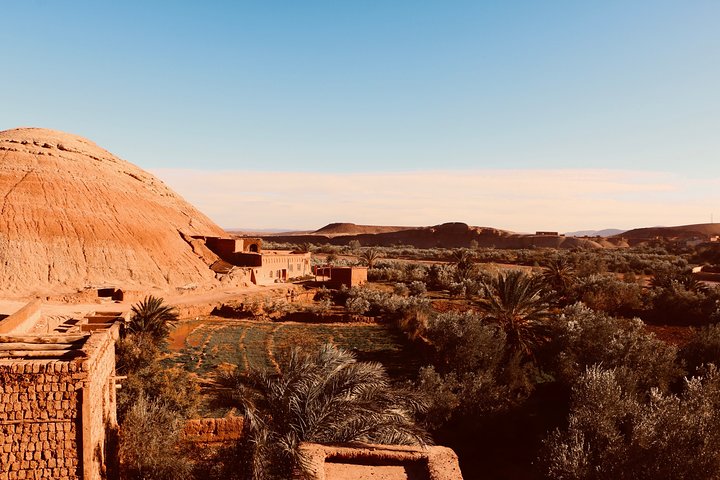
Approximately 30 kilometres northwest of Ouarzazate lies Ait Ben Haddou. This ancient ksar (fortified village) is arguably the most photographed and filmed location in all of Morocco. It is also one of the most dramatic historic sites in North Africa.
UNESCO World Heritage Status
Ait Ben Haddou was designated a UNESCO World Heritage Site in 1987. It was recognised for its outstanding value as an example of traditional earthen architecture. The ksar is built from pisé (rammed earth) and mud brick. It rises in terraces above the Ounila River. Notably, the site has been continuously inhabited for centuries, and a small community still lives within its walls today.
Movies Filmed at Ait Ben Haddou
The kasbah’s dramatic silhouette and labyrinthine alleyways have made it irresistible to filmmakers. In addition to Gladiator and Kingdom of Heaven, it has appeared in Lawrence of Arabia, The Mummy, Prince of Persia, Game of Thrones, Babel, and dozens of other productions. Without doubt, it is one of the world’s most cinematic places.
What to See During Your Visit
To enter Ait Ben Haddou, visitors cross a shallow ford of the Ounila River or take a small bridge. From there, you climb through tiered streets toward the granary at the summit. The views from the top are spectacular golden walls spread out below, and the surrounding plains stretch to the horizon. Allow at least 1.5 to 2 hours to explore. The village below the ksar also has craft shops, cafés, and guesthouses.
Furthermore, Ait Ben Haddou is included in most 3-day desert tours from Marrakech and 5-day desert tours to Merzouga. This makes it easy to combine with the rest of southern Morocco in a single journey.
Top Things to Do in Ouarzazate
1. Visit Atlas Film Studios
A tour of Atlas Studios is the defining Ouarzazate experience for film lovers. Even visitors with little interest in cinema tend to be impressed by the scale and history of the permanent sets.
2. Explore Taourirt Kasbah
Taourirt Kasbah stands right in the centre of Ouarzazate. It was once the residence of the Glaoui family powerful Berber chieftains who ruled much of southern Morocco in the 19th and early 20th centuries. The kasbah is a maze of rooms, corridors, and rooftop terraces. In particular, the decorated reception chambers hint at the family’s former wealth and influence. It is one of the best-preserved kasbahs in Morocco, and admission is inexpensive.
3. Discover the Cinema Museum
The Cinema Museum of Ouarzazate (Musée du Cinéma) is dedicated to the city’s film heritage. Exhibits include costumes, props, posters, and behind-the-scenes photographs from major productions. Moreover, it provides excellent context for an Atlas Studios visit. Together, the two attractions make for a full morning of film tourism.
4. Visit Ait Ben Haddou
The 30-kilometre drive from Ouarzazate to Ait Ben Haddou takes approximately 30 minutes. This is one of the unmissable day trips from the city. The site is a UNESCO fortress, a living film set, and a well-preserved piece of Berber history all in one.
5. Explore the Draa Valley
South of Ouarzazate, the Draa Valley stretches toward Zagora and the Sahara. It follows one of Morocco’s most scenic routes. The valley is lined with date palms, ancient kasbahs, and Berber villages. It is particularly beautiful in late afternoon light. As a result, it makes an excellent half-day or full-day excursion.
6. Day Trips to the Dades and Todra Gorges
Both the Dades Gorge and Todra Gorge lie within a half-day’s drive of Ouarzazate. These dramatic river canyons cut through the High Atlas foothills and are popular with hikers, climbers, and photographers. They also feature prominently in most multi-day Morocco tours from Marrakech.
Ouarzazate – The Gateway to the Sahara Desert
One of Ouarzazate’s most important roles is as the gateway between the Atlas Mountains and the Sahara Desert. Almost every traveller heading from Marrakech to Merzouga or Zagora passes through here. As a result, it has become a natural base for combining film tourism with desert adventure.
Ouarzazate to Merzouga Route
The classic desert route from Ouarzazate to Merzouga covers approximately 320 kilometres. It takes around 4 to 5 hours by road. Along the way, travellers pass through the Dades Valley, the Rose Valley, Todra Gorge, and several Berber oasis towns. This route is widely considered one of the most scenic drives in Africa.
At the end of the route, Merzouga sits at the foot of the Erg Chebbi dunes. There, camel treks and overnight desert camps are the highlight of any Sahara experience. Watching the sunrise over the dunes from a traditional Berber camp is, above all, a memory that stays with travellers for life.
Best Sahara Desert Tours from Ouarzazate
The most popular way to experience this route is on a guided Sahara Desert tour from Marrakech that passes through Ouarzazate. Tilila Travel offers several private tour options:
- 3-Day Desert Tour from Marrakech – The most popular choice for first-time visitors, covering Ait Ben Haddou, Ouarzazate, Dades Valley, Todra Gorge, and Erg Chebbi dunes with a camel trek and desert camp overnight.
- 5-Day Desert Tour from Marrakech to Merzouga – A more leisurely pace with extra time in Ouarzazate and the Draa Valley.
- 3-Day Desert Tour from Fez to Marrakech – Perfect for travellers connecting two imperial cities, with Ouarzazate and Ait Ben Haddou on the final day.
All Tilila Travel desert tours include private air-conditioned transportation, experienced local guides, and flexible itinerary options.
Why Most Desert Tours Pass Through Ouarzazate?
Ouarzazate’s location makes it a natural stop on the Marrakech–Sahara corridor. The N9 road Morocco’s main southern highway passes directly through the city. Therefore, it is the logical stopping point for sightseeing before pushing deeper into the desert. Its film studios, kasbahs, and hotel infrastructure make it an ideal overnight stop rather than just a transit point.
Best Time to Visit Ouarzazate
Ouarzazate has a desert climate. Summers are extremely hot, while spring and autumn offer mild and sunny conditions. Choosing the right season will significantly improve your experience.
Spring (March–May) Best Season
Spring is the best time to visit Ouarzazate. Daytime temperatures are warm but comfortable at 20–28°C. The light is beautiful for photography, and the landscape often carries a subtle green tinge from winter rains. In addition, the Rose Valley to the east blooms during this period, creating a striking landscape of pink and red flowers.
Autumn (September–November) Excellent Alternative
Autumn offers conditions similar to spring — warm, dry, and pleasant. The summer heat has passed. Furthermore, skies are consistently clear and the Sahara is at its most inviting. This is another excellent window for visiting Ouarzazate and continuing to Merzouga.
Winter (December–February) ✓ Good but Cold Nights
Winter days are typically sunny and mild (15–22°C). However, temperatures can drop sharply at night, sometimes below freezing in the desert. The Atlas Mountains above the city may be snow-capped, creating striking visual contrasts. Overall, this is a quieter, less crowded time to visit.
Summer (June–August) Proceed with Caution
Summer temperatures regularly exceed 38–40°C. The heat can make outdoor sightseeing very uncomfortable. If you do visit in summer, book accommodation with air conditioning. Also, plan outdoor activities for early morning or late evening to avoid the worst of the heat.
How Many Days Do You Need in Ouarzazate?
1 Day in Ouarzazate: Ouarzazate Hollywood of Morocco
One day is enough if you are passing through on a desert tour. In that time, you can visit Atlas Film Studios (2 hours), explore Taourirt Kasbah (1 hour), and make the trip to Ait Ben Haddou (half day). This is the standard itinerary for travellers on a 3-day Marrakech to Sahara tour.
2 Days in Ouarzazate
Two days allows for a more thorough exploration of the city and Ait Ben Haddou. You can also add the Cinema Museum and a drive along the Draa Valley road. In addition, the Skoura Palm Grove (45 minutes east) is worth a visit. It is home to beautiful kasbahs, including the Kasbah Amridil.
3 Days – Ouarzazate and the Sahara Desert
Three days creates the perfect itinerary for first-time visitors to southern Morocco:
- Day 1: Ait Ben Haddou + Taourirt Kasbah + Atlas Film Studios
- Day 2: Drive the Draa Valley toward Zagora, or head east toward Skoura and the Dades Valley
- Day 3: Onward to the Sahara or return to Marrakech via Tizi n’Tichka pass
For a seamless experience, contact Tilila Travel to plan a customized itinerary from Marrakech.
Where to Stay in Ouarzazate? Ouarzazate Hollywood of Morocco
Luxury Hotels
Ouarzazate has a solid selection of upscale properties. Most occupy kasbah-style buildings with swimming pools and desert views. The Berbère Palace and Le Zat are frequently recommended at the higher end. These properties are popular with film crews, which adds a distinctive atmosphere to the stay.
Boutique Riads
Several boutique riads in and around the medina offer atmospheric accommodation. These properties typically feature courtyard gardens, Berber décor, and home-cooked Moroccan meals. They provide a more intimate feel and are often excellent value for money.
Desert Lodges
Some travellers prefer to stay just outside Ouarzazate in small desert lodges. Properties in the direction of Ait Ben Haddou, in particular, offer open landscapes and a greater sense of peace. They suit travellers who want to wake up to pure desert views and minimal noise.
Why Visit Ouarzazate with Tilila Travel?
Ouarzazate is rewarding to explore independently. However, the full southern Morocco experience — combining the film city with Ait Ben Haddou, the desert gorges, and the Sahara — is best done with a knowledgeable private guide and reliable transport.
Tilila Travel is a Marrakech-based travel agency specializing in private Morocco tours. Here is why travellers choose us:
- Private transportation in air-conditioned 4×4 vehicles — ideal for desert roads
- Local Berber guides who grew up in southern Morocco and bring its history to life
- Customizable itineraries — you decide how long to spend at each stop
- Seamless Sahara extensions — add Merzouga dunes, camel trekking, and overnight desert camps
- Flexible start points — tours depart from Marrakech, Casablanca, Fez, Agadir, or wherever you are staying
Explore our Morocco desert tours, browse all inclusive Morocco tour packages, or request a tailor-made trip to Morocco built around your dates and interests.
FAQ: Ouarzazate Hollywood of Morocco
Why is Ouarzazate called the Hollywood of Morocco?
Ouarzazate earned the nickname through its long history as a major film production hub. Its vast desert landscapes, ancient kasbahs, and Atlas Film Studios infrastructure have attracted over 200 international productions since the 1960s. These include Lawrence of Arabia, Gladiator, and Game of Thrones.
What movies were filmed in Ouarzazate?
Some of the most famous productions shot here include Lawrence of Arabia (1962), The Mummy (1999), Gladiator (2000), Kingdom of Heaven (2005), Babel (2006), Prince of Persia: The Sands of Time (2010), and Game of Thrones (2013–2014). In total, more than 200 international productions have filmed in the region.
Can you visit Atlas Studios?
Yes. Atlas Studios is open to tourists on most days when filming is not taking place. Guided tours cover the permanent sets, prop warehouses, and production facilities. Tours last approximately 1 to 2 hours and the entrance fee is modest. The studios are located about 5 km from central Ouarzazate.
Is Ouarzazate worth visiting?
Absolutely. Ouarzazate offers a rare combination of film heritage, Berber history, and desert scenery. Even without an interest in cinema, the kasbahs, the UNESCO site of Ait Ben Haddou, and the proximity to the Sahara make it one of the most rewarding stops in Morocco.
How far is Ouarzazate from Marrakech?
Ouarzazate is approximately 200 kilometres from Marrakech by road, via the Tizi n’Tichka mountain pass (2,260 metres). The drive takes around 3.5 to 4 hours. Many travellers include both cities on a desert tour from Marrakech.
Can you visit Ouarzazate on the way to Merzouga?
Yes — almost every Marrakech to Merzouga desert tour stops in Ouarzazate on the first day. It is the natural first major stop on the route. As a result, travellers can visit Ait Ben Haddou and Atlas Studios before continuing east toward the dunes.
How do I book a desert tour that includes Ouarzazate?
Tilila Travel offers a range of private desert tours that include Ouarzazate, Ait Ben Haddou, and the Sahara. Options include the 3-day Marrakech desert tour, the 5-day tour to Merzouga, and the 11-day Morocco tour from Casablanca.