
Credit Cards, Cash & Tipping in Morocco: A Complete Guide for Travelers
At Tilila Travel, we want every guest to feel comfortable and well prepared before arriving in Morocco. Cards, Cash, and Tipping in Morocco: One of the most common questions travelers ask is whether they can use credit cards during their trip, or whether they need to carry cash.
Cards Cash Tipping Morocco Travel Guide
The simple answer is: you should travel with both a credit/debit card and some Moroccan cash. Morocco has modern payment facilities in major cities and tourist areas, but cash is still very important for local experiences, small purchases, tips, and rural destinations.
This guide explains where credit cards are usually accepted, where cash is recommended, and what tipping customs are like in Morocco.
Can Travelers Use Credit Cards in Morocco?
Yes, travelers can use credit cards in many places in Morocco, especially in larger cities and tourist-friendly areas. Visa and Mastercard are the most widely accepted cards. American Express may be accepted in some luxury hotels or high-end establishments, but it is less common.
However, Morocco is not a fully cashless country. Many local businesses, small shops, traditional markets, taxis, and rural areas still prefer or only accept cash. For this reason, we recommend keeping a reasonable amount of Moroccan Dirhams with you during the day.
Places Where Credit Cards Are Usually Accepted
Credit cards are commonly accepted in the following places:
Hotels, Riads & Luxury Accommodation
Most larger hotels, international hotels, luxury riads, and well-established accommodations accept credit cards. In major cities such as Marrakech, Fes, Casablanca, Rabat, Tangier, Agadir, and Chefchaouen, card payment is usually available at higher-end properties.
Smaller traditional riads may also accept cards, but some may prefer cash or apply a small card-processing fee. It is always best to confirm in advance.
Upscale Restaurants & Tourist-Friendly Restaurants
Many restaurants in tourist areas accept credit cards, especially mid-range and high-end restaurants. This is common in places such as Marrakech, Fes, Casablanca, Rabat, Tangier, Agadir, Essaouira, and other popular destinations.
However, smaller local restaurants and family-run places may accept cash only.
Shopping Malls & Modern Stores
Shopping malls, supermarkets, fashion stores, pharmacies, and modern retail shops in major cities usually accept card payments. Examples include modern shopping centers, branded shops, and larger supermarkets.
Museums, Gardens & Tourist Attractions
Some major tourist attractions, museums, gardens, and monuments may accept card payments, especially in larger cities. However, this is not guaranteed everywhere, so it is always wise to carry cash for entrance fees.
Tour Companies & Travel Services
Many professional tour companies, travel agencies, and private excursion providers accept card payments, bank transfers, or online payments. For private Morocco tours, it is common to pay deposits or balances in advance by card or transfer.
During the tour itself, travelers should still carry cash for personal expenses, tips, snacks, small purchases, and optional activities.
Places Where Cash Is Recommended or Required
Cash is still very important in Morocco. Travelers should expect to use Moroccan Dirhams in the following situations:
Souks & Traditional Markets
In the medinas and souks of Marrakech, Fes, Chefchaouen, Essaouira, and other old cities, cash is the most common method of payment. Many small shops, artisan stalls, spice shops, carpet sellers, and souvenir vendors do not accept cards.
Some larger or fixed-price shops may accept cards, but cash is still preferred, especially when bargaining.
Small Cafés, Local Restaurants & Street Food
Traditional cafés, bakeries, small restaurants, juice stands, food stalls, and local eateries often accept cash only. For small amounts, cash is much easier and faster.
Taxis & Local Transport
Most petit taxis, local taxis, and small transport services require cash. Card payment is generally not available in regular taxis.
If you are using a private driver as part of your Tilila Travel tour, the main service is usually arranged in advance, but you may still need cash for personal expenses along the way.
Rural Areas, Mountains & Desert Regions
In rural villages, the Atlas Mountains, desert areas, small towns, and remote regions, cash is essential. ATMs may be limited or unavailable, and card machines may not work reliably.
Before traveling to the Sahara Desert, the Atlas Mountains, or remote destinations, it is best to withdraw enough Moroccan Dirhams in a larger city.
Tips & Small Services
Tips are almost always given in cash. This includes tips for drivers, local guides, porters, housekeeping staff, restaurant staff, and desert camp teams.
It is helpful to keep small notes and coins for tipping and small purchases.
Public Toilets, Parking & Small Local Fees
Some public toilets, parking attendants, luggage helpers, and small local services require a small cash payment. These are usually minor amounts, but having coins or small notes is useful.
Recommended Cash Tips for Travelers
We recommend that travelers carry a combination of:
- A credit or debit card for hotels, larger restaurants, and bigger purchases
- Moroccan Dirhams for daily expenses, tips, souks, cafés, taxis, and rural areas
- Small notes and coins for easy tipping and small payments
ATMs are available in most cities and tourist destinations, but it is better not to wait until you are in a remote area to withdraw money. When traveling to the desert or mountains, withdraw cash in advance.
Credit Cards, Cash & Tipping: Morocco Travel Guide
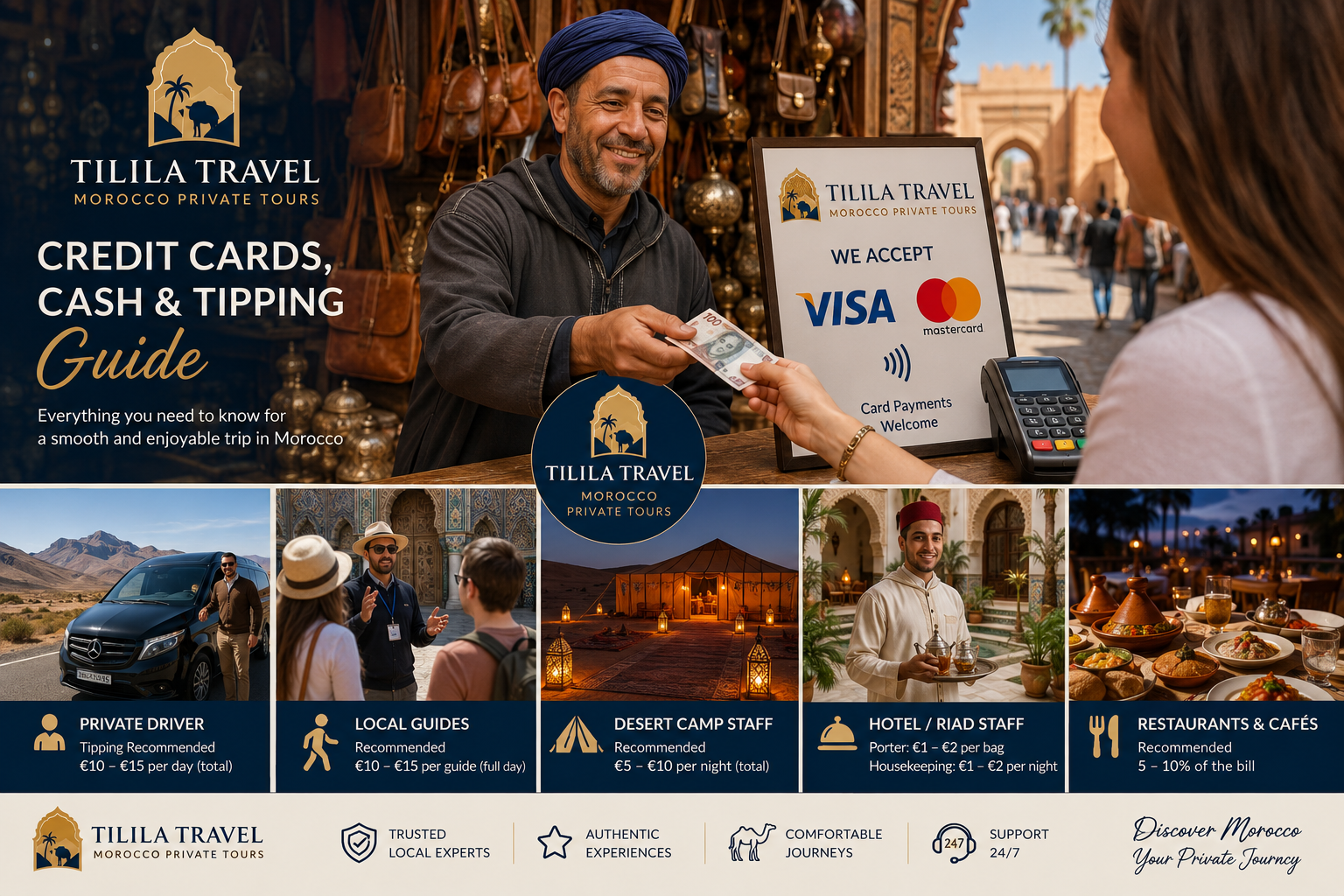
Tipping in Morocco is customary and appreciated, especially in tourism, but it is not obligatory. Tips are always given as a gesture of appreciation for good service, and the amounts are flexible.
The following guidelines are designed to help travelers plan comfortably, without pressure. Tipping should always reflect your satisfaction with the service received.
Private Driver:Cards Cash Tipping Morocco Travel Guide
For many Morocco tours, the private driver is one of the most important people during the trip. Your driver is often with you throughout the journey and assists with transportation, luggage, timing, local advice, comfort, and general support.
Because of this continuous service, the driver’s tip is usually the most significant.
Recommended range:
€10–15 per day total for the travelers together
For example, if two travelers are on the same tour, this amount is normally given as a shared daily amount, not per person.
The best option is usually to keep the tip until the end of the trip and give it as one final thank-you. If you prefer, you may also split it into two parts, such as one part midway through the tour and the rest at the end.
Local Licensed City Guides
In cities such as Fes, Marrakech, Meknes, Rabat, or other historical destinations, travelers may be accompanied by licensed local guides for cultural visits and walking tours,Credit Cards, Cash & Tipping: Morocco Travel Guide
These guides usually provide historical explanations, local context, and assistance through the medina, monuments, and traditional neighborhoods.
Recommended range:
€10–15 per guide for a full-day tour
This is usually given at the end of the guided visit. If the tour is shorter, travelers may adjust the amount according to the length and quality of the service.
Desert Camp & Merzouga Staff
At desert camps or desert-edge lodges in the Merzouga area, staff often assist with luggage, meals, room preparation, camel arrangements, camp comfort, and general hospitality.
Tipping is completely optional, but it is appreciated when service is good.
Recommended range:
€5–10 total per night
This can usually be placed in a general tip box or given to the camp manager to share among the staff. This is often the fairest option because several people may contribute to the guest experience behind the scenes.
Hotel & Riad Staff:Cards Cash Tipping Morocco Travel Guide
Hotel and riad staff in Morocco often provide warm and personal service. Small tips are appreciated, especially when staff help with luggage or housekeeping.
Porters helping with luggage:
€1–2 per bag
Housekeeping:€1–2 per night, left in the room
These tips are not required, but they are a kind gesture when the service is helpful and professional.
Restaurants & Cafés : Credit Cards, Cash & Tipping: Morocco Travel Guide
In tourist-friendly restaurants, tipping is customary when service is good.
Recommended range in restaurants:
5–10% of the bill
In small cafés or casual local places, it is perfectly acceptable simply to round up the bill or leave a few small coins.
Before tipping, travelers may check whether a service charge has already been included. If service is included, an additional tip is optional.
Final Advice from Tilila Travel
Morocco is a welcoming country where hospitality is an important part of the culture. Credit cards are useful in many modern places, but cash remains essential for a smooth and comfortable journey.
For the best experience, we recommend that travelers:
- Carry both a card and Moroccan Dirhams
- Keep small notes and coins for tips and small purchases
- Withdraw cash before traveling to rural areas, mountains, or the desert
- Use cards in hotels, larger restaurants, malls, and modern shops
- Use cash in souks, taxis, small cafés, traditional markets, and remote areas
- Tip only when they feel the service deserves it
Tipping in Morocco is appreciated, never forced. It is simply a thoughtful way to say thank you for good service.
Credit Cards, Cash & Tipping: Morocco Travel Guide
Tilila Travel is always happy to advise guests before and during their trip, so they can enjoy Morocco with confidence, comfort, and peace of mind.
