Why Choose a 10-Day Morocco Highlights Itinerary in 2027
Morocco rewards every traveler who gives it enough time — and 10-Day Morocco Highlights Itinerary 2027 gives you exactly the right balance of depth and discovery. When you follow a 10-day Morocco highlights itinerary, you move beyond the postcard images and experience the country the way locals live it: slowly, warmly, and with great food.
Is 10 Days Enough for Morocco?
Yes — 10 days in Morocco is enough to visit its most iconic destinations without feeling rushed. You will explore Marrakech’s ancient medina, cross the High Atlas Mountains, sleep under the Sahara stars in Merzouga, and wander the medieval streets of Fes. This itinerary covers the best of Morocco in a pace that lets you absorb each place rather than just photograph it.
Best Time to Follow a Morocco Itinerary in 2027
The best months to travel Morocco are March to May and September to November. During these seasons, temperatures stay comfortable warm in the desert and mild in the mountains. Avoid July and August if you dislike extreme heat, especially in Merzouga where daytime temperatures exceed 40°C. Plan your Morocco Sahara Desert tour for sunrise or sunset to catch the golden dunes at their most magical.
What You Will Experience on This Morocco Highlights Tour
On this 10-day tour, you will experience:
The electric energy of Marrakech’s Djemaa el-Fna square at night
The silence and immensity of the Sahara dunes in Erg Chebbi
The UNESCO-listed kasbahs of Aït Benhaddou
The ancient leather tanneries of Fes
The blue-painted alleyways of Chefchaouen
Tilila Travel designs every moment of this itinerary around authentic experiences, not tourist traps.
Luxury vs Classic Morocco Travel Experiences
Luxury Morocco travel means waking up in a candlelit riad with breakfast on the rooftop, sleeping in a private desert camp with ensuite facilities, and having a local expert guide you through places most visitors miss. Classic travel on a budget is also possible across Morocco — the country is incredibly accessible. This guide covers both options so you can plan your Morocco trip according to your style and budget.
Before you pack your bags, understanding the route helps you visualize the journey. This 10-day Morocco highlights itinerary follows a circular route that starts and ends with international flight connections, so you lose no time backtracking.
Morocco Itinerary Route From Marrakech to the Sahara Desert
The route flows south and east from Marrakech, climbing over the High Atlas Mountains before descending into the pre-Saharan valleys. You reach the Sahara dunes at Merzouga on Day 6, then travel north through the Ziz Valley and Middle Atlas forests to reach Fes. The final day takes you to Chefchaouen before your departure.
Main Destinations Included in This Morocco Highlights Itinerary
This itinerary covers four of Morocco’s five imperial cities plus the Sahara:
Marrakech – the Red City and cultural heart of Morocco
Ouarzazate – the gateway to the Sahara and Moroccan film capital
Merzouga – home to the iconic Erg Chebbi sand dunes
Fes – the world’s oldest living medieval city
Chefchaouen – Morocco’s famous Blue City in the Rif Mountains
Driving Distances and Travel Times in Morocco
Route
Distance
Drive Time
Marrakech to Ouarzazate
200 km
3.5 hours
Ouarzazate to Merzouga
320 km
5 hours
Merzouga to Fes
480 km
7 hours
Fes to Chefchaouen
200 km
3 hours
Tilila Travel provides private air-conditioned 4×4 vehicles for all transfers. You stop whenever you want — for photos, mint tea, or a spontaneous souk visit.
Best Airports for a 10-Day Morocco Trip
Fly into Marrakech Menara Airport (RAK) and fly out of Tangier Ibn Battuta Airport (TNG) or Fes-Saïss Airport (FEZ) for the most logical routing. Many European carriers including Royal Air Maroc, Ryanair, and easyJet serve both airports. If you prefer a round-trip from Marrakech, Tilila Travel arranges a comfortable return transfer from Chefchaouen.
Day 1: Arrive in Marrakech – Start Your 10-Day Morocco Highlights Itinerary
Your Morocco adventure begins the moment you land in Marrakech. The warm air carries notes of rose water and cumin — a sensory welcome that tells you immediately: this is not like anywhere you have been before.
Private Airport Transfer in Marrakech
Your Tilila Travel driver meets you at arrivals with a name sign and transfers you directly to your riad in the medina. No apps, no haggling, no stress. Marrakech’s old city is a labyrinth of alleyways where cars cannot enter your driver navigates to the nearest accessible point and helps carry your luggage to the riad entrance.
Explore Djemaa el-Fna Square at Night
After settling in and freshening up, head to Djemaa el-Fna square as the sun sets. This is where Marrakech comes alive. Snake charmers, storytellers, henna artists, acrobats, and dozens of food stalls fill the square with color and noise. Walk through without obligation — you are here to witness one of the world’s great public spectacles, not to buy anything.
Best Traditional Moroccan Food in Marrakech
Eat dinner at one of the elevated restaurants surrounding the square, where you get both the view and the flavor. Order a harira soup to start, then try a lamb tagine with prunes and almonds. If you are adventurous, the grilled sheep’s head stalls on the square serve bold, offal-heavy plates that locals favor. Skip the tourist menus printed in five languages — look for Arabic-only menus and crowds of Moroccans.
Luxury Riad Stay in Marrakech Medina
Tilila Travel books you into a carefully selected traditional riad — a courtyard home converted into a boutique guesthouse. These properties hide their beauty behind plain exterior walls: step inside and discover mosaic tilework, carved plaster ceilings, orange trees, and rooftop terraces. A quality luxury riad in Marrakech costs between $150–$400 per night and includes breakfast. Explore our recommended Marrakech riads.
Day 2: Marrakech Sightseeing Tour – Explore Morocco’s Red City
Marrakech deserves a full day of unhurried exploration. Your private guide accompanies you through the city’s most celebrated sites, giving context that no guidebook can match.
Visit Bahia Palace and Koutoubia Mosque
Start your Marrakech sightseeing tour at the Bahia Palace, a 19th-century masterpiece built for a grand vizier’s harem. The palace covers eight hectares and features 150 rooms, fragrant gardens, and intricate zellij tilework. Your guide explains the politics and love stories embedded in every courtyard.
From Bahia Palace, walk toward the medina’s central landmark: the Koutoubia Mosque. Non-Muslims cannot enter, but the exterior a 70-meter minaret visible from across the city is worth seeing up close. Built in the 12th century, it served as the architectural model for Seville’s Giralda tower.
Discover the Famous Marrakech Souks
The souks of Marrakech are organized by trade leather workers here, spice sellers there, lantern makers around the corner. Your guide leads you through the Souk Semmarine and into the specialist markets beyond, helping you understand fair prices so you can shop confidently. Moroccan artisans are proud of their craft: watch a babouche (slipper) maker cut and stitch leather by hand, or a copper artisan hammer geometric patterns into a tea tray.
Visit Majorelle Garden and Yves Saint Laurent Museum
In the afternoon, visit the Majorelle Garden a botanical paradise designed by French painter Jacques Majorelle in the 1920s and restored by Yves Saint Laurent in 1980. The cobalt blue buildings, cacti, and lily ponds create a serene contrast to the medina’s energy. Book tickets in advance as queues move slowly. Directly beside it, the Yves Saint Laurent Museum showcases the designer’s lifelong love affair with Morocco and his collections inspired by Moroccan color and form.
Traditional Moroccan Hammam Experience
End Day 2 with a hammam Morocco’s traditional bathhouse ritual. A hammam session includes a steam room, black soap (beldi) scrub, and a full body exfoliation by an attendant. Tilila Travel books you into a reputable traditional hammam rather than a tourist spa, so you experience the ritual as Moroccans do. Cost: approximately $20–$50 for a traditional hammam, $80–$150 for a luxury spa experience.
Day 3: Atlas Mountains & Berber Villages Tour From Marrakech
Leave Marrakech behind on Day 3 and climb into one of Africa’s most dramatic mountain ranges the High Atlas. The landscape shifts quickly from red city dust to green terraced valleys and snow-capped peaks.
Drive Through the High Atlas Mountains
Your private 4×4 departs early to make the most of the light. The road south rises steadily through olive groves and Berber villages before reaching altitudes above 2,000 meters. Jebel Toubkal — North Africa’s highest peak at 4,167 meters dominates the horizon on clear days. Stop frequently for photographs: the views from hairpin bends reward patience.
Visit Authentic Berber Villages in Morocco
The Berber people or Amazigh, “the free people” have inhabited these mountains for thousands of years. Your guide introduces you to a Berber village community where families still build stone houses, practice traditional agriculture, and weave carpets on handlooms. You are not visiting a performance — you are meeting neighbors. Bring small gifts (school supplies or dates are appropriate) and always ask permission before photographing people.
Scenic Stops in the Ourika Valley
The Ourika Valley offers some of the Atlas’s most accessible beauty: a rushing river flanked by walnut trees, saffron farms, and terraced gardens. Visit a small argan oil cooperative run by Berber women and learn how this Moroccan superfood goes from tree to bottle. Try fresh argan oil on bread with hone it tastes nothing like the processed version sold internationally.
Experience Traditional Berber Hospitality
Lunch with a Berber family includes whatever is seasonal: lamb tagine with root vegetables, homemade flatbread (khobz), and mint tea served three times (tradition demands three glasses one for life, one for love, one for death). This meal alone is worth the drive from Marrakech.
Day 4: Aït Benhaddou & Ouarzazate – Morocco Kasbahs and Desert Gateways
Day 4 is your first crossing of the High Atlas a journey that has separated the Saharan south from the Atlantic north for millennia. The Tizi n’Tichka pass is Morocco’s most dramatic road.
Cross the Tizi n’Tichka Pass
The Tizi n’Tichka pass reaches 2,260 meters above sea level. The road winds through bare rock faces, occasional snow patches, and roadside argan fossil sellers. Stop at the summit for photos and to buy a warm Berber scarf temperatures here drop sharply even in summer. Descend southward and notice how the landscape transforms: red earth replaces green valleys, and palm trees appear in dry riverbeds.
Explore Aït Benhaddou UNESCO World Heritage Site
Aït Benhaddou is the most celebrated kasbah in Morocco and one of the most filmed locations on earth. Game of Thrones, Gladiator, Lawrence of Arabia, and The Mummy all used this fortress city as a backdrop. Climb through the earthen towers with your guide, who explains how families still lived inside until the 1990s. A handful of families remain today, selling crafts and maintaining the structures. The views over the Ounila River valley from the top are genuinely spectacular.
Visit Ouarzazate and Atlas Film Studios
Ouarzazate calls itself the Hollywood of Africa. The Atlas Film Studios the world’s largest film studio by land area — offer guided tours through sets that have hosted everything from Star Wars to Prison Break. Even if you are not a film enthusiast, walking through an ancient Egyptian temple made entirely from painted polystyrene is an unexpectedly fun experience.
Best Kasbah Experiences in Southern Morocco
Beyond Aït Benhaddou, southern Morocco hides dozens of lesser-known kasbahs and ksour (fortified villages). Ask your guide to stop at Taourirt Kasbah in Ouarzazate — built by the powerful Glaoui clan in the 20th century, it contains the most elaborate interior decoration of any kasbah in the region. Entry costs just $3 and crowds are rare.
Day 5: Dades Valley & Todra Gorge – Scenic Morocco Road Trip Experience
Day 5 is pure road-trip pleasure a journey through Morocco’s most dramatically varied landscapes along a route locals call the Road of a Thousand Kasbahs.
Discover the Road of a Thousand Kasbahs
The Route of a Thousand Kasbahs (Route 9) runs east from Ouarzazate through the Draa and Dades valleys. Every few kilometers, a new earthen fortress rises from a palm grove beside a dry riverbed. Stop at Skoura to walk through the palm oasis, and at El Kelaa M’Gouna — the Valley of Roses — where Morocco produces 80% of the world’s rose water every May during the famous Rose Festival.
Visit Todra Gorge and Dramatic Canyon Landscapes
Todra Gorge is one of Morocco’s most stunning natural wonders. A narrow canyon — just 10 meters wide in places — rises 300 meters on either side, the towering walls glowing amber and rust in the afternoon light. Rock climbers from across Europe use Todra as a serious training site. Walk the gorge floor with a cold water stream at your feet and the sky reduced to a thin blue strip above. Explore Todra Gorge photography tips.
Explore Traditional Desert Villages in Morocco
The Dades Valley (Gorges du Dadès) rewards those who look beyond the main road. Hidden villages cling to canyon walls, connected by footpaths rather than roads. Your guide knows the families in several of these villages a stop for tea often turns into a spontaneous tour of a traditional Berber home, with its central hearth, sleeping areas arranged around the walls, and a rooftop for stargazing.
Best Photography Stops in Dades Valley
The Monkey Fingers rock formations near Aït Oudinar are Dades Valley’s most photographed feature twisted volcanic columns resembling outstretched hands. Photograph them in the golden hour before sunset for maximum drama. The valley road itself, winding between canyon walls and palm groves, produces compelling travel photography at almost every corner.
Day 6: Sahara Desert Tour in Merzouga – Luxury Desert Camp Experience
Day 6 is the heart of your Morocco itinerary — the day you reach the Sahara Desert and everything you imagined about Morocco becomes real.
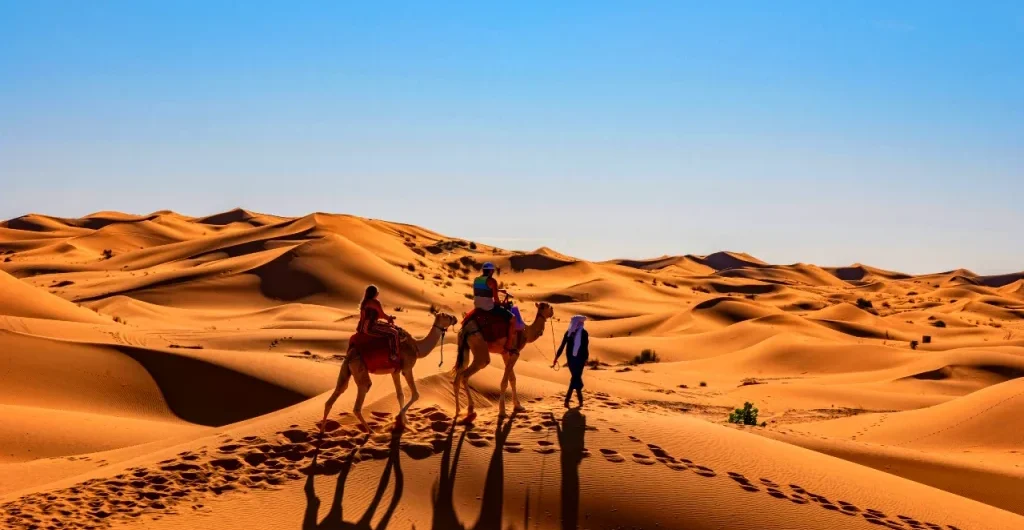
Camel Trekking in Erg Chebbi Dunes
Erg Chebbi near Merzouga contains Morocco’s largest sand dunes some rising 150 meters above the surrounding plain. Your Merzouga camel trek departs at 4:30 PM, precisely timed for the desert’s golden hour. Your camel (they prefer to be called dromedaries) sways rhythmically as you ascend into the dune sea. The only sounds are wind, sand, and the soft footfalls of the caravan ahead.
Luxury Sahara Desert Camp Under the Stars
Tilila Travel sets you up in a luxury desert camp — not the basic canvas tents sold by budget operators, but proper glamping: furnished Berber-style tents with real beds, solar-powered electricity, ensuite bathrooms, and a dining area. Dinner is served by firelight: a full Moroccan spread including harira, briouats (fried pastry rolls), tagine, and fresh fruit.
Watch the Sunset in the Sahara Desert
The Saharan sunset is unlike any other on earth. The dunes shift from gold to orange to deep crimson as the sun drops. Your guide leads you to a dune ridge where you sit in silence — no city noise, no car engines, nothing but the wind reshaping the landscape in real time. Bring a warm layer: desert temperatures drop sharply after sunset, even in summer.
Experience Gnawa Music and Berber Culture
After dinner, local Gnawa musicians perform around the campfire. The Gnawa tradition — rhythmic, trance-inducing music played on guembri bass lutes and metal castanets has roots in sub-Saharan Africa and West African spiritual practices. UNESCO added Gnawa music to its Intangible Cultural Heritage list in 2019. Listen with attention: this is living culture, not a performance for tourists.
Why Merzouga Is the Best Sahara Desert Destination in Morocco
Morocco has two main Sahara destinations: Merzouga (Erg Chebbi) and Zagora (Erg Chigaga). Merzouga wins for most travelers because the dunes are taller and more visually dramatic, the infrastructure is better developed, and the journey from Marrakech combines more sights along the way. Compare Merzouga vs Zagora if you are deciding between them.
Day 7: Ziz Valley to Fes – Scenic Journey Through Morocco
Leaving the Sahara feels bittersweet, but Day 7’s drive northward through the Ziz Valley offers its own rewards — an entirely different Morocco from the red-rock south.
Drive Through the Beautiful Ziz Valley Oasis
The Ziz Valley is Morocco’s longest palm oasis — over 100 kilometers of date palms following an underground river through bare rock desert. Villages of pink-mud houses cluster at the oasis edge. The contrast between the orange cliffs and the dense green palm canopy produces some of Morocco’s most striking natural scenery. Stop at the Hassan Addakhil Dam viewpoint above Errachidia for a panoramic photograph.
Middle Atlas Mountains and Cedar Forest Stops
North of Midelt, the landscape shifts dramatically again. The Middle Atlas Mountains receive genuine winter snow and support a landscape that surprises most visitors expecting only desert: rolling green meadows, cedar forests, and mountain rivers. Stop at the Azrou Cedar Forest where wild Barbary macaques (often mistakenly called monkeys) approach roadside visitors freely. Do not feed them directly but they photograph beautifully.
Visit Ifrane – The Switzerland of Morocco
Ifrane is Morocco’s strangest and most charming detour. Built by the French during the Protectorate in Alpine-chalet style, the town looks genuinely European: red-roofed chalets, a manicured town square, and a famous carved stone lion. Ifrane is home to the prestigious Al Akhawayn University and is surrounded by Morocco’s largest ski resort (Michlifen). Stop for a coffee and a crêpe — yes, really.
Arrive in the Historic City of Fes
As you descend toward Fes in the late afternoon, the ancient medina appears below — a dense carpet of rooftops, minarets, and souks spreading across a river valley. Check into your riad in the Fes el-Bali medina and let the call to prayer from the nearby mosque announce your arrival. Explore Fes travel tips before your full medina day tomorrow.
Day 8: Fes Medina Guided Tour – Explore Morocco’s Cultural Capital
Fes is to Morocco what Rome is to Europe a city where every stone carries centuries of history. You need a licensed guide here: the Fes medina has over 9,000 streets, and even experienced travelers get genuinely lost.
Visit Al Quaraouiyine University
Al Quaraouiyine (also spelled Al-Qarawiyyin) is the oldest continuously operating university in the world — founded in 859 AD. UNESCO and the Guinness World Records recognize it as such. The university and its attached mosque dominate the heart of the medina. Non-Muslims cannot enter the mosque, but your guide shows you the entrance gates and explains the institution’s role in Islamic scholarship, law, and mathematics for over a thousand years.
Explore the Ancient Fes Medina
The Fes el-Bali medina is a UNESCO World Heritage Site and the world’s largest car-free urban area. Donkeys remain the primary mode of transport for goods. Your guide navigates the medieval street system: past foundouks (ancient caravanserais), through the metalworkers’ souk ringing with hammers, and into the quiet residential quarters where life has changed little since the 14th century.
Visit Chouara Tanneries in Fes
The Chouara Tanneries are Fes’s most iconic sight and its most pungent. Workers stand in round stone vats of natural dyes (poppy red, indigo blue, henna brown, saffron yellow) and pomegranate skin, working leather by foot as their predecessors did a thousand years ago. Viewing terraces in surrounding leather shops offer the best bird’s-eye perspective. Accept the sprigs of mint offered at the entrance — you will need them. Read our Fes tanneries photography guide.
Discover Traditional Moroccan Handicrafts
Fes produces Morocco’s finest traditional crafts. In the Medina artisan quarter, watch master craftsmen create:
Fassi pottery — blue and white geometric ceramics unique to Fes
Zellige tilework — hand-cut mosaic tiles requiring years of training
Embroidery — silk threadwork using the distinctive Fassi stitch
These are not mass-produced souvenirs. A quality zellige table costs $300–$800 and represents weeks of skilled labor. If you buy one item in Morocco, buy it in Fes.
Best Hidden Places in Fes Medina
Ask your guide to take you to the Nejjarine Fountain, the Andalusian Mosque (exterior), and the Bab Bou Jeloud gate — the decorated blue-and-green tiled entrance to the medina that appears in every Fes travel photograph. For lunch, find a restaurant on a rooftop terrace overlooking the medina roofscape and order pastilla (Morocco’s extraordinary savory-sweet pastry) for the table.
Day 9: Chefchaouen Excursion – Visit Morocco’s Famous Blue City
Day 9 takes you northwest into the Rif Mountains to one of Morocco’s most photographed and beloved destinations the Blue City of Chefchaouen.
Why Chefchaouen Is a Must-Visit Destination in Morocco
Chefchaouen (also spelled Chaouen or Chefchaouen) was founded in 1471 as a refuge for Muslims and Jews expelled from Spain. The blue-painted walls and doors that define the city today began as a Jewish tradition — blue symbolizes the sky and heaven and spread gradually through the medina. The city sits in a green mountain valley at 600 meters elevation, making its climate noticeably cooler and fresher than Morocco’s lowland cities.
Best Photography Spots in Chefchaouen
You will photograph Chefchaouen obsessively — every alleyway and doorway offers a composition. The best Chefchaouen photography spots include:
Ras el-Maa waterfall — a natural spring at the medina’s edge, popular with local women washing wool
The Spanish Mosque — reached by a 20-minute walk uphill, offering panoramic views over the blue medina against mountain backdrop
Rue Sidi Salem — the medina’s most photogenic street, with layered blue tones and flower pots
Plaza Uta el-Hammam — the main square where cats outnumber tourists in the early morning
Visit by 7:00 AM for empty streets and soft light. By 10:00 AM the crowds arrive from Fes and Tangier.
Explore the Blue Streets and Mountain Views
Spend the morning exploring without a plan — Chefchaouen rewards aimless wandering more than structured tours. The medina is small enough to understand quickly and safe enough to explore solo. Follow streets uphill until you find the city walls, then walk the ramparts for views over terracotta rooftops and blue domes.
Shopping for Handmade Moroccan Crafts
Chefchaouen specializes in woolen crafts — blankets, djellabas (hooded robes), and woven bags produced by Rif Mountain artisans. The wool is locally sourced, naturally dyed, and hand-woven on traditional looms. Prices are reasonable: a quality woolen blanket costs $30–$60, a handwoven bag $10–$25. Avoid shops on the main tourist square — walk two streets back for authentic workshops.
Day 10: End of Your 10-Day Morocco Highlights Itinerary
Your final morning in Morocco deserves to be savored rather than rushed. Rise early for one last rooftop breakfast, pack deliberately, and let the memories settle before the journey home.
Private Departure Transfer in Morocco
Tilila Travel arranges your private departure transfer from Chefchaouen to Tangier Airport, Casablanca Airport, or Fes Airport depending on your flight. The Chefchaouen–Tangier drive takes approximately 2.5 hours on a well-paved mountain road. Chefchaouen–Fes takes 3 hours. Book your flight for early afternoon to allow comfortable transfer time without rushing.
Last-Minute Shopping in Morocco
If you have morning time before your transfer, Chefchaouen’s medina opens by 8:00 AM. Pick up:
Argan oil — buy from women’s cooperatives, not souvenir shops, for authentic cold-pressed product
Moroccan spice mixes (ras el hanout) — sealed and labeled, they pass airport security easily
Hammam black soap (beldi) — sold in every pharmacy for $2–$5
Declare any significant purchases at customs. Morocco allows exports of cultural goods under $1,000 without documentation.
Tips Before Leaving Morocco
A few final practical notes:
Tip your guide and driver — standard is $10–$15 per person per day for guides, $5–$10 for drivers
Exchange remaining dirhams before departure — Moroccan dirhams are not convertible outside the country
Keep your accommodation receipts — some airports ask to verify currency exchange legitimacy for large cash amounts
Complete your green arrival card — if you still have the stub from entry, surrender it at the border on departure
Morocco does not let go of you easily. Most travelers begin planning their return before they even board the plane home. Start planning your next Morocco journey.
What Is Included in This 10-Day Morocco Tour Package
Tilila Travel’s 10-day Morocco highlights package includes everything you need for a seamless journey through the country’s most celebrated destinations.
Private Transportation in Morocco
All ground transportation runs in private air-conditioned vehicles — Toyota Land Cruisers or Mercedes Sprinters depending on group size. You travel only with your own group. No shared shuttles, no strangers, no fixed departure times. Your driver speaks English and Arabic, knows every road, and doubles as a logistical problem-solver if anything changes.
Luxury Riads and Desert Camps
Tilila Travel selects accommodations that reflect genuine Moroccan character rather than generic hotel comfort:
Marrakech: Traditional riad in the medina with courtyard, rooftop terrace, and hammam
Ouarzazate area: Boutique kasbah hotel with mountain views and traditional architecture
Merzouga: Private luxury desert camp with ensuite tents and stargazing terrace
Fes: Historic riad in Fes el-Bali medina with carved plaster and zellige tilework
Chefchaouen: Boutique guesthouse with mountain views and blue medina access
Every city on the itinerary includes a licensed local guide not a generalist, but a specialist who knows their own city. Your Marrakech guide grew up in the medina. Your Fes guide studied at Al Quaraouiyine. This local expertise transforms sightseeing into genuine cultural exchange.
Daily Breakfasts and Moroccan Dinners
The package includes:
Daily breakfasts at your accommodation — fresh-baked msemen flatbreads, amlou (argan paste with honey), fresh-squeezed orange juice, and Moroccan mint tea
6 dinners at selected restaurants, riads, and the desert camp, featuring traditional Moroccan cuisine
1 Berber family lunch in the Atlas Mountains (included on Day 3)
Lunches during city days are at your own choice and expense — your guide recommends the best options for every budget.
Best Accommodation Options for a Morocco Highlights Itinerary
Where you sleep in Morocco shapes your entire experience of the country. Tilila Travel works with properties that prioritize authenticity and quality over square footage and swimming pools.
Luxury Riads in Marrakech and Fes
A luxury riad in Marrakech or Fes typically costs $150–$400 per night for a double room. For this price, expect:
Private courtyard with fountain or orange trees
Handcrafted interior with zellij tiles, carved plaster, and painted cedar ceilings
Rooftop terrace with medina views
On-site hammam
Personalized breakfast service
The best Marrakech riads cluster in the Mouassine and Bab Doukkala neighborhoods — close enough to Djemaa el-Fna to walk but far enough to escape the noise. Browse our curated Morocco riad selection.
Best Sahara Desert Camps in Merzouga
Not all desert camps are equal. Tilila Travel’s standard for a quality Merzouga luxury desert camp includes:
Ensuite tent facilities — not shared bathrooms across the camp
Real beds, not floor mattresses with thin foam
Solar power for charging devices and electric lighting
Private camp location — at least 1 km from standard budget camps
Fresh-cooked dinner and breakfast on-site
Budget camps cost $50–$80 per tent. Mid-range camps run $100–$200. Luxury private camps cost $300–$600 for a couple and are worth every dirham for the silence and space.
Boutique Hotels With Authentic Moroccan Design
Between the big cities, Tilila Travel selects boutique properties that use traditional craft and local materials:
Dades Valley: Small guesthouses in the gorge built from local stone, with terraces overlooking the canyon
Ouarzazate area: Restored kasbah hotels where the building itself is the attraction
Ifrane / Middle Atlas: Mountain lodges with fireplaces and forest views for the overnight stop
These properties connect you to the landscape and community in ways that international hotel chains cannot.
How Much Does a 10-Day Morocco Highlights Itinerary Cost in 2027?
Morocco is one of the world’s best-value luxury travel destinations. You can experience a genuinely high-quality 10-day tour at a fraction of comparable trips in Europe, Southeast Asia, or the Middle East.
Luxury Morocco Tour Prices
A luxury 10-day private Morocco tour with Tilila Travel typically costs $2,500–$4,000 per person based on double occupancy. This includes:
Private 4×4 transportation throughout
Luxury riad and desert camp accommodation (9 nights)
Licensed local guides in all cities
Daily breakfasts + 7 dinners
All entrance fees and cultural experiences listed in the itinerary
A mid-range 10-day Morocco tour runs $1,200–$2,000 per person with comfortable hotels instead of luxury riads, standard desert camps, and group transportation on fixed routes.
Budget Tips for Traveling in Morocco
Independent travelers can see Morocco for $60–$100 per person per day including accommodation, food, and transport:
Stay in well-rated hostels or budget riads ($20–$40/night)
Eat at medina restaurants popular with locals ($5–$10 per meal)
Use CTM and Supratours buses between cities ($10–$25 per journey)
Hire local guides per day rather than booking packages ($30–$60/day)
The main cost of budget travel in Morocco is time — bus journeys take longer than private transfers, and navigating cities without a guide means missing layers of context that a good guide provides.
What Affects Morocco Tour Prices?
Key factors that influence your Morocco tour cost:
Travel season — peak season (March–May, September–November) costs 15–25% more than shoulder season
Group size — private tours for 2 cost more per person than groups of 4–6
Inclusions — guides, meals, entrance fees, and activities all add to base transport cost
Customization — tailor-made itineraries with off-the-beaten-path additions cost more than standard routes
Essential Morocco Travel Tips for First-Time Visitors
Morocco requires minimal preparation but rewards visitors who arrive with practical knowledge. These tips make your journey smoother from arrival to departure.
Is Morocco Safe for Tourists in 2027?
Yes — Morocco is one of Africa’s safest tourist destinations. The country invests heavily in tourist infrastructure and the tourism police (Brigade Touristique) actively patrols major medinas. Violent crime against tourists is extremely rare. The main risks are:
Unofficial guides — touts who offer to show you around and then demand payment or lead you to high-commission shops. Solution: book through Tilila Travel and meet your licensed guide at the riad.
Petty theft — pickpocketing in crowded souks. Solution: carry a crossbody bag, not a backpack, and keep your phone in your front pocket.
Aggressive selling in tourist shops. Solution: feel free to say “la shukran” (no thank you) firmly and walk away.
Women traveling solo in Morocco experience regular unsolicited attention. Dress conservatively in medinas, walk confidently, and ignore comments without eye contact. Joining Tilila Travel’s women’s Morocco tours provides additional security and community.
What to Wear in Morocco
Morocco is a Muslim-majority country with moderate, urban social norms. Pack:
Lightweight, loose clothing that covers shoulders and knees for medinas and rural areas
One warm layer for mountain driving and desert nights
Comfortable walking shoes — medina streets are uneven cobblestone
A breathable scarf — doubles as sun protection, mosquito guard, and a modesty cover for mosque visits
Beach destinations (Essaouira, Agadir) are more relaxed about dress. Casablanca and Rabat are westernized enough that shorts are common downtown.
Morocco Currency, SIM Cards & Internet Tips
Currency: Moroccan Dirham (MAD). As of 2027, roughly 10 MAD = $1 USD / €0.92. Dirhams are not convertible outside Morocco — only exchange what you will use.
Cash: Morocco is still largely cash-based outside upscale restaurants and hotels. ATMs are widely available in all cities and dispense dirhams from international cards.
SIM card: Buy a Maroc Telecom or Orange SIM card at the airport on arrival — approximately $5–$10 for 10GB of data. This covers maps, translation apps, and WhatsApp communication with your Tilila Travel team throughout the trip.
Wi-Fi: Most riads and hotels offer free Wi-Fi. Desert camps may have limited connectivity — treat this as a feature.
Cultural Etiquette and Tipping in Morocco
Morocco’s culture is warm and hospitable. Honor it with these simple practices:
Greet people with “Salam alaykum” (peace be upon you) when entering shops or meeting new contacts
Remove shoes before entering a home or mosque interior
Accept tea when offered — refusing is impolite. You do not have to drink all three glasses.
Ask permission before photographing people
Tip appropriately — guides $10–$15/day, drivers $5–$10/day, hotel staff $1–$2 per service, restaurant servers 10% where service is not included
Best Travel Insurance for Morocco Trips
Morocco does not require travel insurance for entry, but you should carry comprehensive coverage that includes:
Medical evacuation (costs can exceed $50,000 without insurance)
Trip cancellation and interruption
Baggage loss and delay
Adventure activities if you plan to hike or trek
Recommended providers for Morocco travel: World Nomads, Allianz Travel, and IMG Global. Purchase insurance at the time of booking your flights, not the day before departure.
Best Moroccan Foods to Try During Your 10-Day Morocco Itinerary
Moroccan cuisine is one of the world’s great food traditions — complex in flavor, generous in portion, and deeply tied to hospitality culture. Eat well on this itinerary: every city has its own specialties.
Traditional Moroccan Tagine
Tagine is Morocco’s national dish — a slow-cooked stew prepared in a conical earthenware vessel that captures and recirculates steam. Common varieties include:
Lamb tagine with prunes and almonds — Marrakech’s signature, sweet and savory
Chicken tagine with preserved lemon and olives — bright, tangy, served with flatbread
Vegetable tagine with seven vegetables — the traditional Friday variety, hearty and filling
Kefta tagine with eggs — spiced minced lamb meatballs baked in tomato sauce, a street-food favorite
Tagines cook for 2–4 hours and taste best at lunch when they have been simmering since morning. Avoid tagines at tourist restaurants near major sights — they are often pre-cooked and reheated. Ask your Tilila Travel guide for the best local tagine restaurants in each city.
Authentic Friday Couscous
Couscous is traditionally served on Fridays in Moroccan homes — the equivalent of Sunday lunch in a European family. Hand-rolled semolina steamed above a broth of lamb, vegetables, and chickpeas produces a texture that packaged couscous cannot replicate. If your itinerary places you in a Moroccan city on a Friday, ask your guide to find a home-style restaurant serving the family version.
Pastilla – Morocco’s Famous Sweet & Savory Dish
Pastilla (also written bastilla or bstilla) is Morocco’s most theatrical dish. Layers of paper-thin warqa pastry enclose a filling of shredded pigeon or chicken with eggs, almonds, and warming spices — then the whole pie is dusted with powdered sugar and cinnamon. The combination of sweet, savory, crispy, and rich in a single bite is genuinely unlike any other culinary experience. Fes is considered the pastilla capital of Morocco — order it on Day 8.
Moroccan Mint Tea Culture
Moroccan mint tea (atay) is far more than a beverage — it is a social ritual, a welcome gesture, and a business negotiation tool. Made from gunpowder green tea steeped with fresh spearmint and sweetened generously with sugar, it is poured from height to create froth and served three times (tradition says you must accept all three rounds). Never rush this ritual. The tea ceremony communicates that you have time for people, and Moroccans respect that.
Street Food Experiences in Marrakech and Fes
Both Marrakech and Fes offer extraordinary street food scenes that rival any in the world:
Marrakech street food highlights:
Merguez sandwiches — spiced lamb sausages grilled over charcoal, $1–$2
Maakouda — fried potato fritters in a sesame roll, $0.50
Snails in broth (bourgour) — a Djemaa el-Fna specialty, eaten with a toothpick from the shell, $1
Fes street food highlights:
Msemen — pan-fried flaky flatbread with honey or kefta, $0.50
Briouat — deep-fried pastry filled with cheese or minced lamb, $0.50 each
Harcha — semolina and butter flatbread sold warm from bakeries, $0.30
Eat where Moroccans eat. A busy stall with local customers turning over quickly is a guarantee of freshness and quality.
Frequently Asked Questions About a 10-Day Morocco Highlights Itinerary
Is 10 Days Enough to See Morocco?
Ten days lets you cover Morocco’s essential highlights comfortably without rushing. You see four major cities (Marrakech, Ouarzazate, Fes, Chefchaouen), the Sahara Desert, the High Atlas Mountains, and the Dades and Ziz valleys. What 10 days does not cover: Casablanca, Rabat, Essaouira, the Atlantic coast, and the deep south near Zagora. These destinations work well on a second Morocco trip or as extensions of this itinerary.
What Is the Best Morocco Itinerary for First-Time Visitors?
For first-time visitors, the Marrakech–Sahara–Fes–Chefchaouen circuit is universally recommended. It includes Morocco’s most distinctive experiences (the medinas, the desert, the mountains) without requiring difficult logistics or unusual infrastructure. This is exactly the route this 10-day Morocco highlights itinerary follows.
Should I Visit Chefchaouen During a 10-Day Morocco Trip?
Yes — Chefchaouen is one of the world’s most visually distinctive small cities and it adds relatively little travel time when positioned at the end of a Fes-based day. The Blue City photographs extraordinarily well and offers a refreshing contrast to the intensity of Marrakech and Fes. Most travelers name it among their favorite stops on the entire itinerary. Plan your Chefchaouen visit with our dedicated destination guide.
What Is the Best Time to Visit the Sahara Desert?
The best months for a Sahara Desert tour in Morocco are October, November, February, March, and April. During these months, daytime temperatures in Merzouga range from 20–30°C — warm but comfortable. Summer months (June–August) see temperatures exceeding 45°C, making outdoor activities genuinely dangerous between 10 AM and 5 PM. Winter nights (December–January) can drop to near freezing in the desert — bring a warm sleeping bag if you camp in this period.
How Much Does a Morocco Desert Tour Cost?
A camel trek and one-night desert camp in Merzouga costs:
Budget: $50–$80 per person (basic camp, shared facilities)
Mid-range: $100–$200 per person (comfortable camp, ensuite tents)
Luxury: $300–$600 per couple (private camp, gourmet dinner, premium bedding)
When you book through Tilila Travel’s 10-day Morocco package, the luxury desert camp is fully included in the tour price.
Can Families Travel Comfortably in Morocco?
Morocco is an excellent family destination. Children receive particularly warm welcomes across the country — Moroccan culture is deeply child-centered. Practical family considerations:
Request an SUV with child seats from Tilila Travel (available at no extra charge with advance notice)
The camel trek in Merzouga works for children 5 and older
Riads often have rooftop terraces that require supervision with small children
Most Moroccan food suits children: tagines, flatbreads, fresh orange juice, and pastries are universally popular
Do I Need a Guide for Morocco?
You do not legally require a guide anywhere in Morocco. However, a good licensed guide in Fes or Marrakech transforms your experience from confusion to understanding. The medinas are genuinely complex — the Fes medina alone has over 9,000 streets — and a guide provides not just navigation but historical context, language support, and social connection with local artisans and families. Tilila Travel includes licensed local guides at every major city stop.
What Should I Pack for a Morocco Itinerary?
Essential Morocco packing list:
Lightweight layers — Morocco’s temperature varies dramatically between coast, mountain, and desert
Why Book Your 10-Day Morocco Highlights Itinerary With Tilila Travel: 10-Day Morocco Highlights Itinerary 2027
Authentic Local Moroccan Travel Experts
Tilila Travel is founded and operated by Moroccan travel professionals who were born and raised in the regions you visit. Your Fes guide is not reading from a script — he grew up praying at Al Quaraouiyine. Your desert guide learned to navigate by stars before he owned a compass. This local knowledge is the difference between a tour that informs and one that transforms.
Private Tailor-Made Morocco Tours
Every Tilila Travel itinerary is customized to your group — dates, pace, accommodation level, dietary requirements, physical ability, and personal interests. We do not run fixed departure tours with strangers. You share your vehicle only with your travel companions, and you decide when to stop, linger, or move on.
Luxury and Cultural Experiences Across Morocco
Tilila Travel’s standard for luxury is Moroccan: handmade, locally sourced, and rooted in centuries of craftsmanship. We do not put you in anonymous five-star hotels. We put you inside the culture — in riads where the owner greets you by name, at dinner tables where the recipes have not changed in three generations, in desert camps where the silence is the luxury.
Experienced Drivers and Professional Guides
All Tilila Travel drivers hold Moroccan professional transport licenses and carry comprehensive insurance. They know Morocco’s mountain roads and desert pistes in every season. Our guides carry official licenses from Morocco’s Ministry of Tourism and receive ongoing training in heritage interpretation, first aid, and customer service. Meet our team.
Flexible Morocco Itineraries for Couples, Families & Groups
Honeymoon couples: extra romance touches — rose petals, private dinners, sunset camel rides for two
Families with children: child-paced exploration, child-friendly accommodation, activity modifications
Photography groups: adjusted timing for golden-hour stops, exclusive access to artisan workshops
Wellness travelers: hammam and spa additions, yoga at the desert camp, organic food focus
Contact Tilila Travel to begin planning your 10-day Morocco highlights itinerary for 2027. We respond within 24 hours and offer free initial consultations by video call.
What our travellers say
Posted on Google
Michael Sengl
Trustindex verifies that the original source of the review is Google.
We booked a 2 day private tour to the desert and had a great experience. The organization was smooth and everything went as planned. Both Mohamed, the manager, and Abdel, our guide, did an outstanding job! I fully recommend booking with Tilila Travel 👍🏻
Posted on Google
Magally Palacios
Trustindex verifies that the original source of the review is Google.
Excellent trip. I feel like a Morrocan princess all the time in those luxurous hotels. Awsome time. God bless Morrocan people.
Posted on Google
Paresh Shah
Trustindex verifies that the original source of the review is Google.
My wife and I travelled in Morocco in early May. We used Tililia travel through a friend suggestion. The experience was wonderful. Our driver Yousef was terrific and was there from the start to the finish. He was there to pick us up from the airport, and drop us off at the end of the trip. We had plans and activities arranged every day and had the ability to make minor changes as deemed be necessary. The guides were good. We always felt safe and never had any issues communicating as everyone spoke English. We thoroughly enjoyed our time in Morocco, and Tililia travel was a large part of the reason for a wonderful vacation. I would definitely recommend them for anyone visiting Morocco.
Posted on Google
Ronly
Trustindex verifies that the original source of the review is Google.
We just finished our tour yesterday. We love our tour guide, and we thoroughly enjoyed every moment of this tour. The tour has great balance among culture, nature, and historical sites. Our guide is super patient, kind, and attentive. He waited for our slow walking family members. When someone needs bathroom or water stop, he finds the clean roadside restaurants/shops. We have took guided tours in different countries. Our Morocco guide is head and shoulder above all the other tour guides we had before. Above was my trip in 2019. I just went again in March 2023. The tour is well organized. Itinerary was given to us in advance. There’s no surprise. Everything went smoothly. The driver was waiting for us at the airport. He drives the whole tour, polite, helpful, and always on time. The city guide in Fez was exceptional, she tailored tour to our specific interests. The cooking class arranged by Mohammed, the owner of Tilila Tour was amazing. Every time I make those dishes, I will be thinking about this trip. It was a great memory making trip.
Posted on Google
Stephanie Wattel
Trustindex verifies that the original source of the review is Google.
Le voyage organisé au Maroc a été une expérience très enrichissante. L’itinéraire était bien planifié et permettait de découvrir des paysages variés, entre les médinas animées, le désert du Sahara et les montagnes de l’Atlas. Les guides étaient accueillants et compétents, ce qui a rendu les visites encore plus intéressantes. L’organisation générale était satisfaisante, avec des hébergements confortables et des déplacements bien gérés. Ce séjour m’a permis de mieux connaître la culture marocaine, sa gastronomie et l’hospitalité de ses habitants. Un voyage dépaysant que je recommande vivement.
Posted on Google
Nisha
Trustindex verifies that the original source of the review is Google.
I was connected with Tilila travels through Rough Guides. We worked with Mohamed , the owner, on the details and he accommodated all of our changes/request and were able to create a trip based on timing, budget, duration and things we wanted to see in Morocco. Communication prior and during the trip was excellent. Our trip started off with a guided tour of Marrakech with our guide, Ibrahim, who was fantastic - helped us find some off the grid souks and gave us a unique local perspective into Marrakech and its history that we would never have received on our own. I also was not feeling too hot and he made sure to check in and make stops when needed. Our driver, Mohamed (not the tour owner), for our 9 day road trip around Morocco, was a true superstar. He made our trip such an amazing adventure, paying attention to our likes and dislikes and really took care of us like family. All of our stops (Dades Gorge, Fes, Chefchaouen, Rabat, and Casablanca) were incredible to experience and the local city guides assigned to us took it to another level. The only exception was the Sahara desert camp which just wasn’t our cup of tea, but Mohamed the owner did address our feedback which was nice. Other than that, the whole trip was amazing and we would recommend Tilila to anyone looking to visit Morocco.
Posted on Google
Lynda Boyer
Trustindex verifies that the original source of the review is Google.
My husband and I took a 9-day tour of Morocco with Tilila Travel in April 2026. Our expectations were exceeded! The company is very professional and responsive, but most importantly they were there for us every time! We felt completely safe and cared for while we traveled across the beautiful country of Morocco. I have some mobility issues, and Tilila was great about making accommodations for me. They let me pick and choose activities, and they were able to shorten some things that were too hard for me. Accommodations were beautiful and some of them were really wonderful! All of them were comfortable and our needs were always met. When my husband was hit with a GI bug, our driver took us to a pharmacy where he was able to get antibiotics and felt better quickly! Speaking of drivers, Walid was the best! Kind, patient and the best driver I ever saw. Always available and treated us so well! We LOVED our trip and would always recommend Tilila Travel!
Posted on Google
Syed Ali
Trustindex verifies that the original source of the review is Google.
We had a fantastic experience on this trip and really enjoyed every part of it. The itinerary through Casablanca, Rabat, Chefchaouen, Fes, the Sahara, and Marrakech was very well planned, and everything ran smoothly. All the accommodations were exactly as described—comfortable, clean, and well located. A special mention for our driver, Ali, who was friendly, punctual, and very professional throughout. He made the long drives easy and was always accommodating. The Sahara experience was a highlight—the camel ride and ATV were especially memorable. For an 8-day trip, there is naturally quite a bit of driving involved. If we were to do it again, we might consider trimming one or two stops just to allow for a slightly more relaxed pace—but overall, the itinerary was very enjoyable and well put together. Overall, the service and execution were excellent. We would definitely recommend this tour to anyone looking for a well-organized and memorable Morocco experience.
Posted on Google
Gülsüm Yılmaz
Trustindex verifies that the original source of the review is Google.
With Tilila Travel, we took a 5-day tour from the ocean to the desert. The tour by car was safe, comfortable, and full of fun. The desert, which I saw for the first time, impressed me greatly. I am very grateful to Tilila Travel, especially to our guide Mustapha and to my friends who made the journey unique.
Posted on Google
Vincent Cusenza
Trustindex verifies that the original source of the review is Google.
Tilila Travel gave us personal, prompt, polite, and extremely solicitous attention to all of our requests and travel needs. They arranged beautiful lodging, sensible schedules, and excellent local tour services. A great outfit to deal with. Our driver Tawfiq was a hoot. We spent many hours on the road in conversation about Morocco and life on both sides of the ocean. He had boundless energy and enthusiasm, and always bent over backwards with great local advice for touring, eating, and sightseeing. We all laughed and sang a lot on our long travel days, while we listened to his playlists of Moroccan folk and dance music. He was on call for us in the evenings, and drove us to restaurants and entertainment, taking all of the worry out of navigating the cities. Tawfiq was more like a travel buddy than a driver, and infinitely better than Uber!