Travel Tips for First Timers to Morocco | 2026 Guide | Tili La Travel
The moment you step into Marrakech’s Djemaa el-Fna, your senses will overload the smell of cumin and charcoal smoke, the sound of Gnawa drums, the kaleidoscope of spice pyramids and snake charmers blurring into one overwhelming, beautiful chaos. And right then, most first-timers make their first mistake: they panic.
But here’s what the guidebooks won’t tell you that chaos has a rhythm. Once you learn it, Morocco becomes the most rewarding destination on earth.
At Tili La Travel, we’ve spent years guiding first-timers through Morocco’s medinas, mountain passes, and desert dunes. We’re not a package holiday operator. We’re Morocco specialists born, based, and deeply rooted in this country and we’ve designed this guide specifically for people who’ve never set foot here before.
By the end of this page, you’ll navigate souks like a local, spot the 5 scams that catch 90% of first-timers off guard, know exactly what to wear, what to eat, what to avoid, and how to build the perfect itinerary. Whether you’re planning 7 days or 10, solo or with family this is your complete Morocco first-timer survival guide for 2026.
Landing in Morocco for the first time is exhilarating and slightly overwhelming. Here’s exactly what happens from the moment your plane touches down, so nothing catches you off guard.
At the Airport
Most first-timers fly into Marrakech Menara Airport or Mohammed V International Airport in Casablanca. Both are modern, well-signposted, and relatively easy to navigate. You’ll clear passport control quickly Morocco doesn’t require a visa for citizens of the US, UK, EU, Canada, or Australia for stays under 90 days. Simply present your passport and onward travel confirmation.
Currency exchange booths are available at both airports, though the rates inside terminals are noticeably worse than in the city. If you need dirhams immediately, withdraw just enough cash for your taxi and first meal, then exchange more in the medina or at a bank branch.
Getting to Your Riad or Hotel
This is where your first decision matters enormously. Official airport taxis in Marrakech operate on fixed rates — always confirm the price before getting in and only use the licensed white taxis from the official rank. In Casablanca, the train from the airport directly to the city centre is the smoothest, cheapest option and takes about 30 minutes.
Avoid anyone inside the arrivals hall who approaches you offering “the best taxi” or “private transfer.” These are almost always touts connected to specific riads or shops, not genuine transport services. If you’ve booked with Tili La Travel, your airport pickup will be arranged in advance with a named driver holding a sign simple, safe, and stress-free.
Entering the Medina for the First Time
The medinas of Marrakech and Fes are UNESCO World Heritage Sites and among the most disorientating urban environments on earth. Streets narrow to shoulder width. Dead ends appear without warning. Maps become useless. This is not a failure of your navigation — it is the nature of medinas, which were deliberately built as labyrinthine for defensive purposes centuries ago.
Our strongest advice: accept that you will get lost on your first day. Embrace it. Keep your riad’s address written in Arabic on your phone (ask reception to send it to you), and when genuinely lost, any shopkeeper will help you find the main square for a dirham or two or simply out of genuine kindness. Moroccans are overwhelmingly hospitable to visitors.
The Sensory Adjustment
Morocco is loud, fragrant, and relentlessly alive. The call to prayer sounds five times a day from minarets across the city. Mopeds will accelerate past you in alleyways with inches to spare move to the side and let them pass, this is normal. Cats are everywhere, especially in medinas, and they are considered sacred in Islamic tradition. Street food vendors, musicians, and henna artists will call out to you. A smile and a polite “la shukran” (no thank you) is all you need.
Within 24 hours, the chaos begins to feel familiar. Within 48, you’ll be navigating shortcuts through the souk like you’ve been doing it for years.
This is the question every first-timer asks, and the answer is more nuanced and more reassuring than many Western travel blogs suggest.
The Honest Safety Picture
Morocco is one of the most politically stable countries in North Africa and consistently ranks as one of the safest destinations on the continent. The country has a significant tourist infrastructure, a well-trained tourist police force (Brigade Touristique) that operates specifically to protect visitors in major medinas, and a government that takes tourism safety seriously as a core economic priority.
Violent crime against tourists is rare. In over a decade of guiding travellers through Morocco, the team at Tili La Travel has never had a client experience physical harm. The risks that do exist are almost entirely in the category of petty scams, opportunistic overcharging, and the kind of confidence tricks that target disoriented newcomers not violence.
The 5 Scams That Target 90% of First-Timers
Understanding these before you arrive will save you money and frustration:
Scam 1 — The Fake Guide: A friendly local approaches you near the entrance to the medina and offers to show you around “for free.” Nothing is free. At the end of the tour, you’ll be deposited at a cousin’s carpet shop with heavy social pressure to buy. Solution: book a licensed guide through a reputable agency or your riad.
Scam 2 — The Henna Artist: A woman approaches you in Djemaa el-Fna, begins applying henna to your hand before you’ve agreed, then demands an extortionate fee. Solution: if you want henna, negotiate and confirm the price explicitly before any application begins.
Scam 3 — The Spice Shop “Free Sample”: You’re invited inside a spice shop for tea and a tour. The hospitality is genuine, but the exit involves enormous social pressure to purchase overpriced saffron or argan oil. Solution: it’s absolutely fine to accept tea and leave without buying. Practice saying “la shukran” with confidence.
Scam 4 — The Wrong Taxi Meter: Petit taxi drivers sometimes claim the meter is broken and quote a fixed price that is three times the standard rate. Solution: always insist on the meter. If it’s genuinely broken, agree on a price before departure or take a different taxi.
Scam 5 — The Djemaa el-Fna Photo Charge: Snake charmers and monkey handlers in the main square will invite you to photograph them or place their animal on your shoulder. Once the photo is taken, they demand payment. Solution: photograph from a distance with a zoom, or agree on a price beforehand.
Travel Tips for First Timers to Morocco
Is Morocco Safe for Solo Female Travelers?
This deserves a direct answer: yes, with preparation. Thousands of solo women travel Morocco safely every year. The primary challenge is persistent, sometimes exhausting, attention from men in medina areas not physical danger. Dressing modestly, walking with confidence, avoiding eye contact with persistent harassers, and staying in well-reviewed riads in central medina locations dramatically reduces friction. Many solo female travellers find that travelling with even one companion (male or female) eliminates most unwanted attention entirely.
If you’re a solo female traveller planning your first Morocco trip, our private tours for solo travellers are designed specifically with your experience and comfort in mind.
Same-sex relationships are legally prohibited in Morocco, and public displays of affection for any couple — are culturally discouraged. LGBTQ+ travellers do visit Morocco successfully by exercising appropriate discretion, but this is a personal risk assessment each individual must make with full awareness of the legal context.
Health and Medical Safety
Morocco’s cities have good private hospitals and pharmacies are excellent pharmacists here have strong clinical knowledge and can advise on common travel ailments. Tap water is not recommended for drinking in most cities; bottled water is cheap and universally available. Standard travel vaccinations (typhoid, hepatitis A) are recommended by most travel health clinics, though not mandatory.
3. What to Wear in Morocco: The Dress Code Explained
Morocco is a Muslim-majority country with a relaxed but genuine dress culture, and understanding it will not only earn you respect from locals — it will make your entire experience more comfortable and immersive.
The Core Principle
Modest dress is not a strict legal requirement for tourists in Morocco, but it is a social expectation, particularly in medinas, religious sites, and rural areas. Marrakech’s Djemaa el-Fna and beachside areas in Agadir are slightly more tolerant of Western dress. Inside mosques (the few open to non-Muslims), covered arms, legs, and head are required.
What to Wear as a Woman?
The most practical and respectful approach is to cover your shoulders and knees in public spaces. Loose linen trousers, maxi skirts, and long-sleeved lightweight tops work beautifully in Morocco’s climate and are widely sold in the souks if you don’t want to pack them. A light scarf is invaluable it doubles as a head covering for mosque visits, a wrap for cool evenings in the Atlas Mountains, and a barrier to unwanted attention in crowded medinas.
You do not need to wear a hijab or jellaba as a tourist. What you’re aiming for is coverage, not cultural imitation. Shorts and sleeveless tops are fine at beach resorts, pool areas at riads, and in the privacy of your accommodation.
What to Wear as a Man?
Men face fewer restrictions but should similarly avoid walking through medinas shirtless or in very short shorts. Long trousers or shorts to the knee are perfectly acceptable. Many male visitors enjoy buying a traditional jellaba from the souk a full-length robe that is both culturally respectful and practically cool in the Moroccan heat.
Packing Essentials for Morocco
The climate varies dramatically by region and season. Marrakech can reach 42°C in July, making it extremely hot during the day. In contrast, the Sahara can drop below 5°C at night in January. Meanwhile, Chefchaouen in spring offers mild and refreshing weather.
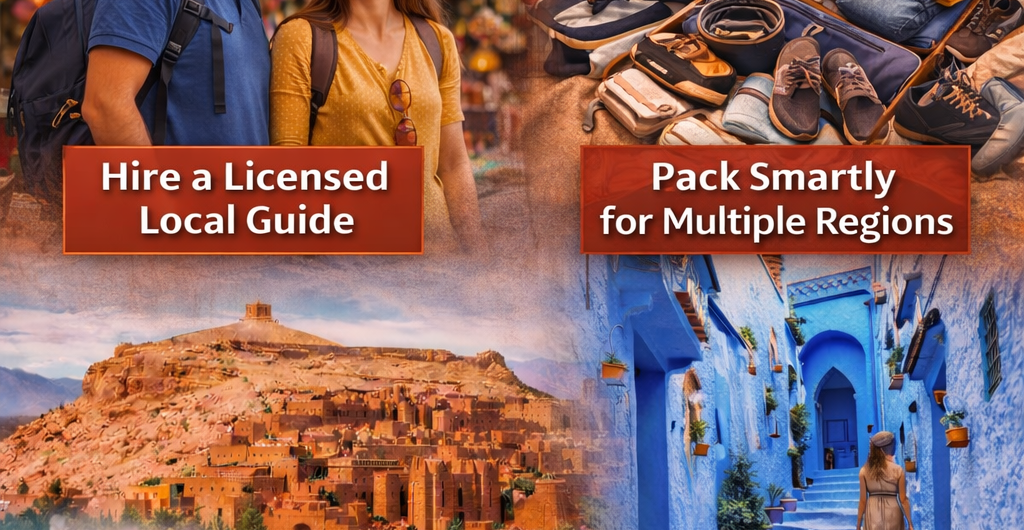
For a 7–10 day trip across multiple regions, it’s important to pack smart. Bring lightweight, breathable layers to stay comfortable in changing temperatures. A compact rain jacket is useful for Fes and the northern areas. Comfortable closed-toe walking shoes are essential for the uneven medina streets. Don’t forget a universal plug adaptor, as Morocco uses European Type C sockets. High-factor sun protection is also a must.
Leave white clothing at home the narrow streets and moped exhaust will ruin it within a day.
4. Money Matters: Currency, Tipping, and Haggling
Getting comfortable with Morocco’s money culture will transform your experience from frustrating to fun. This section covers everything you need to know about dirhams, tipping etiquette, and the art of the souk negotiation.
The Moroccan Dirham (MAD)
Morocco’s currency is the Moroccan Dirham (MAD), abbreviated as “dh” in everyday use. It is a closed currency, meaning you cannot purchase dirhams outside Morocco and cannot legally export them when you leave. Don’t bother trying to source dirhams before your flight exchange currency on arrival instead.
The best exchange rates are consistently found at bank branches (Attijariwafa, BMCE, and Banque Populaire are widespread) and official bureau de change offices in city centres. ATMs are reliable and widely available in major cities, though some charge withdrawal fees. As of 2025, a rough budget guide: budget travellers spend approximately 400-600 MAD per day; mid-range travellers 800-1,500 MAD; and comfortable travellers 2,000+ MAD. One US dollar exchanges to approximately 10 MAD.
Tipping Culture in Morocco
Tipping is expected in Morocco and forms a meaningful part of service workers’ income. The standard practice: round up taxi fares generously, tip restaurant servers 10% in sit-down establishments (though it’s often not added automatically to the bill), and tip your guide 100-200 MAD per day depending on the tour length and quality. Riad staff who carry bags, make reservations, or go above and beyond appreciate 20-50 MAD. At hammams, tip your attendant 30-50 MAD.
Never feel pressured to tip for services you didn’t request or agree to but do tip generously when service has been genuinely excellent.
The Art of Haggling in the Souks
Bargaining in Moroccan souks is not optional it is the entire point. Fixed-price shops exist and are often labelled as such, but in traditional souk stalls, the stated
price is always the opening position in a negotiation, not the final price.
The golden rule: the first price you’re quoted is typically two to three times the fair market value. Counter at about 30-40% of the opening price, and expect to settle somewhere in the middle. The process should be friendly and playful if a vendor becomes aggressive or you feel uncomfortable, simply walk away. This usually produces an immediate, better offer.
Two critical points: first, never begin negotiating seriously unless you genuinely intend to buy if the right price is reached it’s considered disrespectful to walk away after both parties have agreed on a price. Second, once you’ve handled an item and shown serious interest, the social dynamic shifts. Browse casually before engaging, and pick up only what genuinely interests you.
5. 7-Day & 10-Day Itinerary Blueprints for First Timers
Morocco rewards slow travel, but even a week gives you an extraordinary range of experiences. Here are our two signature blueprint itineraries for first-timers both customisable through Tili La Travel’s private tour packages.
The 7-Day Morocco Blueprint
Day 1-2 — Marrakech: Arrive, acclimatise. Explore the Djemaa el-Fna at dusk, visit the Bahia Palace
and Majorelle Garden in the morning, spend an afternoon getting deliberately lost in the souks. Evening: traditional dinner with live Gnawa music.
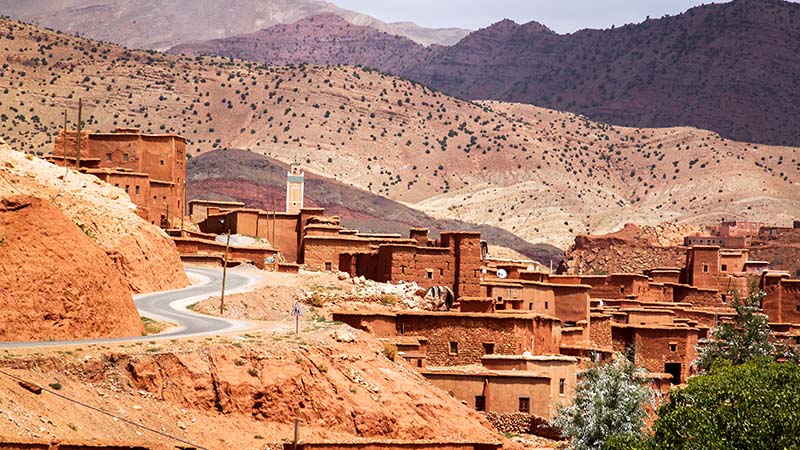
Day 3 — Atlas Mountains Day Trip: Drive through the Tizi n’Tichka pass to a Berber village in the High Atlas. Lunch with a local family, optional mule trek to a mountain waterfall. Return to Marrakech for the evening.
Day 4 — Transfer to Fes via Ifrane: A scenic drive through cedar forests and the Swiss-looking town of Ifrane, arriving in Fes by early evening. Check into your riad in the medina.
Day 5-6 — Fes el-Bali: Two full days in the world’s oldest living medieval city. Visit the Bou Inania Medersa, watch the famous tanneries from the leather merchants’ terraces (above a shop is the only legitimate vantage point), explore the Andalusian quarter, and v
isit the ancient Kairaouine University — the oldest continuously operating university on earth.
Day 7 — Departure: Return to Marrakech or Fes airport depending on your flight.
The 10-Day Morocco Blueprint
Everything in the 7-day plan, plus:
Day 7-8 — Sahara Desert (Merzouga): Drive from Fes through the Ziz Valley and date palm oases to Merzouga. Arrive in time for a camel trek into the Erg Chebbi dunes, sunset over the Sahara, overnight in a luxury desert camp under one of the world’s most spectacular starscapes.
Day 9 — Draa Valley & Ait Benhaddou: Drive back west through the Draa Valley, stopping at the ancient ksar of Ait Benhaddou — a UNESCO World Heritage Site and filming location for Gladiator, Game of Thrones, and Lawrence of Arabia.
Day 10 — Return to Marrakech: Final morning in Marrakech for last-minute souk shopping and a traditional hammam experience before your flight home.
For a fully tailored version of either itinerary — including family-friendly adjustments, solo traveller modifications, or luxury upgradesTili La Travel’s Morocco specialists for a personalised quote.
Moroccan cuisine is one of the great cooking traditions of the world, and eating your way through the country is one of the genuine joys of any first visit. But there are a few practical rules that protect your health and your palate.
What You Must Eat?
Tagine is Morocco’s iconic slow-cooked stew lamb with prunes and almonds, chicken with preserved lemon and olives, vegetable tagine with seven spices all cooked in the distinctive conical clay pot. The best tagines are not found in tourist-facing restaurants but in small local daries (family eateries) tucked into the medina’s back streets.
Couscous is traditionally served on Fridays as a communal meal after the midday prayer. If you’re invited to share couscous with a Moroccan family, consider it one of the highest honours of your trip. In restaurants, Friday lunch is the best time to order it.
Harira is a thick, warmly spiced soup of tomatoes, lentils, and chickpeas, traditionally eaten to break the Ramadan fast but available year-round. It’s extraordinarily nourishing, costs almost nothing from street vendors, and is arguably the most underrated dish in Morocco.
Msemen and Beghrir are Moroccan pancakes the former flaky and griddle-cooked, the latter spongy with a thousand tiny holes that trap melted butter and honey. Breakfast in Morocco is a genuinely beautiful meal.
Mint tea three glasses, as tradition holds is not optional. It is the cornerstone of Moroccan hospitality. Always accept it when offered. Refusing is mildly offensive. The tea is sweet, fragrant, and served with theatrical height from the teapot.
Djemaa el-Fna transforms after dark into one of the world’s great open-air food courts. Stalls numbered by the municipality offer merguez sausages, snail broth (more delicious than it sounds), sheep’s head (adventurous eaters only), fresh-squeezed orange juice for 4 MAD, and mountains of grilled meats and flatbreads. The numbered stalls are regulated and broadly safe choose stalls with high turnover and visible cooking.
What to Avoid?
Tap water across most Moroccan cities is chlorinated but not recommended for visitors whose stomachs aren’t adapted to local bacteria. Always drink bottled or filtered water, and be cautious about ice in drinks at informal establishments. Salads and raw vegetables washed in tap water can occasionally cause issues eat these only at well-reviewed restaurants.
Avoid the tourist-facing “traditional restaurants” at Djemaa el-Fna’s perimeter where touts aggressively pull you toward seating. The food is adequate, the prices are inflated, and the experience is designed for quick turnover rather than genuine Moroccan hospitality. Walk three streets into the medina and eat where the locals eat prices drop by 70% and quality rises dramatically.</p>
Can You Drink Alcohol in Morocco?
Yes. Morocco is a Muslim-majority country where alcohol is legal and available in licensed restaurants,
international hotels, and some dedicated bottle shops. You will not find alcohol sold in medina areas or local cafes this is a cultural boundary worth respecting. Wine is produced in Morocco and the local rosés and reds are genuinely excellent and very affordable.
7. The Perfect First-Timer Morocco Itinerary
If you’ve read this far, you understand why Morocco requires more thoughtful planning than most destinations. The country is large, geographically diverse, and culturally layered and the gap between a spectacular first trip and an exhausting, disorganised one often comes down to the sequencing of your itinerary.
The perfect first-timer Morocco itinerary follows a simple principle: start where it’s most intense, build in recovery time, and end in the desert or mountains where pace slows naturally.
Begin in Marrakech it’s the most tourist-adapted city and the ideal place to find your Morocco footing. Spend two full days, not one. Most first-timers underestimate the medina’s scale and leave feeling they’ve rushed it. A leisurely morning in the souks, an afternoon at Majorelle Garden, and an evening at Djemaa el-Fna tells you more about Moroccan life than any museum.
Move to Fes next, ideally via a night or two in the Middle Atlas. Fes is more conservative, more authentically medieval, and more intellectually rich than Marrakech. Give it two full days minimum. Hire a licensed guide here unlike in Marrakech, Fes’s medina is genuinely impossible to navigate without one, and a good guide transforms it from confusing to revelatory.
If your itinerary allows, close with the Sahara. Nothing prepares you for the emotional impact of watching the sun set over the Erg Chebbi dunes in silence. It is the image that first-timers take home and never forget.
For a fully designed, privately guided version of this itinerary including luxury riad bookings, licensed local guides in every city, private transport, and 24/7 on-the-ground support explore TiliLaTravel’s signature Morocco tours.
8. Why Booking with a Local Agency Makes All the Difference
There’s a significant difference between booking a Morocco trip through a Western package operator and booking directly through a speciali
st local agency like Tili La Travel. Here’s what that difference actually looks like in practice.
Local Knowledge That No Algorithm Can Replicate
When you book with a local Moroccan specialist, you’re accessing knowledge that is lived, not researched. Your guide knows which souk stall sells genuine saffron and which sells coloured grass. They know which riad in the Fes medina has the quietest rooms and which has the best rooftop for sunrise. They know when the Djemaa el-Fna is best to visit (Sunday evenings, if you’re asking), which mountain road is closed after rain, and which local family in the Atlas genuinely welcomes guests for couscous and which is a tourist-facing performance.
This isn’t information you can find on TripAdvisor. It accumulates over years of living and working here.
Real-Time Problem Solving
Travel in Morocco occasionally involves unexpected changes a mountain pass closed by snowfall, a festival blocking your planned route, a riad double-booking. When you book through a local agency, these problems are solved before you even notice them. When you book through a foreign operator or on your own, you’re managing them in a foreign language from a foreign country with foreign time zones.
Direct Economic Impact
When your travel spend goes through a local Moroccan agency, a dramatically higher proportion reaches local guides, drivers, family-run riads, and community-based experiences. Tili La Travel partners exclusively with Moroccan-owned accommodation, employs licensed local guides from the cities they guide in, and actively supports Berber community tourism initiatives in the Atlas and Sahara regions. Your trip funds the communities you come to experience.
The Peace of Mind Premium
The single most common feedback we receive from clients who’ve booked with Tili La Travel after previously attempting Morocco independently is this: “I wish I’d done it this way the first time.” Not because Morocco is too difficult to navigate independently experienced travellers absolutely can but because the mental overhead of constant logistics decisions consumes energy you’d rather spend on actually experiencing the country.
We handle the airport transfers, the riad check-ins, the guide coordination, the restaurant reservations, the desert camp booking, the camel trek timing, and the hundred small decisions that, independently, exhaust you. You handle the wonder.
Ready to Plan Your First Morocco Trip?
Whether you’re thinking about a 7-day highlights tour, a 10-day journey through imperial cities and the Sahara, a private family adventure, or a solo experience with the safety of expert local support — we’d love to help you design it.Get in touch with the TiliLaTravel team for a free, no-obligation consultation. We’ll build your itinerary around your interests, travel style, budget, and timeline and make sure your first Morocco trip is exactly as extraordinary as it should be.
FAQ: Travel Tips for First Timers to Morocco
1. Is Morocco safe for first-time travelers?
Yes. Morocco is one of North Africa’s safest tourist destinations, with a dedicated tourist police force (Brigade Touristique) operating in all major medinas. Violent crime against visitors is rare. The main risks are opportunistic scams and overcharging, which are easily avoided with basic preparation. Millions of first-timers visit Morocco safely every year.
2. What should I avoid in Morocco?
Avoid accepting unsolicited guide offers near medina entrances, agreeing to henna application without confirming the price first, drinking tap water, taking unmarked taxis, and photographing people without permission. Also avoid wearing revealing clothing in medina and religious areas, as this can attract unwanted attention and is considered disrespectful.
3. Can you drink alcohol in Morocco?
Yes. Alcohol is legal in Morocco and available at licensed restaurants, international hotels, and dedicated bottle shops. It is not served in medina cafes, local restaurants, or in public. Moroccan wine, particularly rosé from the Meknes region, is widely available and good quality.
4. Do they speak English in Morocco?
English is spoken reasonably well in tourist-facing businesses in major cities like Marrakech and Fes, and increasingly among younger Moroccans. The official languages are Arabic (Darija dialect) and Tamazight (Berber). French is widely used in business and is more useful than English in non-tourist areas. Learning a handful of phrases in Darija “shukran” (thank you), “la shukran” (no thank you), “bshal hada?” (how much is this?) is warmly appreciated.
5. How much money do I need per day in Morocco?
Budget travellers can manage on 400-600 MAD (approximately $40-60 USD) per day, covering basic accommodation, street food, and local transport. Mid-range travellers typically spend 800-1,500 MAD ($80-150 USD). Comfortable travellers in quality riads with sit-down meals should budget 2,000+ MAD ($200+ USD) per day excluding pre-booked tours.
6. Is Morocco friendly to American tourists?
Very much so. Moroccans are widely regarded as among the most hospitable people in the world, and Americans are welcomed warmly. The US and Morocco have had a treaty of friendship since 1786 the oldest US diplomatic relationship still in force. American passports receive visa-free entry for up to 90 days.
7. What is considered rude in Morocco?
Refusing tea when offered as a gesture of hospitality, photographing people without permission (especially women), public displays of affection, entering a mosque without invitation if you’re non-Muslim, using your left hand to pass food or gifts, and beginning souk negotiations without genuine intent to buy are all considered rude or disrespectful in Moroccan culture.</p>
8. What is the best time to visit Morocco for first-timers?
March to May and September to November are the ideal windows temperatures are mild across all regions, the Sahara is not at its most
extreme heat, mountain roads are clear, and tourist crowds are manageable. December through February is excellent for Marrakech and the south but cold in the Atlas. July and August bring intense heat to inland cities and peak tourist season.
9. What should first-timers pack for Morocco?
Pack lightweight, modest clothing (shoulders and knees covered), comfortable closed-toe walking shoes, a universal European-style plug adaptor, high-factor sunscreen, a headscarf (versatile for women), a portable phone charger, and any prescription medications in original packaging. Leave expensive jewellery at home. A small day-bag is more practical than a large rucksack for navigating medinas.
10. Do I need a guide for Morocco as a first-timer?
Morocco can be explored independently, but hiring a licensed local guide is highly recommended in certain areas. In Fes, the medina is complex, even by Moroccan standards. Without guidance, it’s easy to get lost.
For Atlas Mountain treks and Sahara excursions, a guide adds both safety and local insight. In Marrakech, booking a guide for your first day can save hours of confusion. It also helps you avoid common scams.
Guides arranged through reputable local agencies like Tili La Travel are licensed and English-speaking. They also offer a more informative and reliable experience than freelancers approached on the street.